60GHz vs 24GHz mmWave Sensors: Range and Micro-Motion Compared
A 60GHz vs 24GHz mmWave sensors comparison of detection range and micro-motion reach. This guide shows when a 60GHz unit beats a 24GHz sensor for hotel rooms.
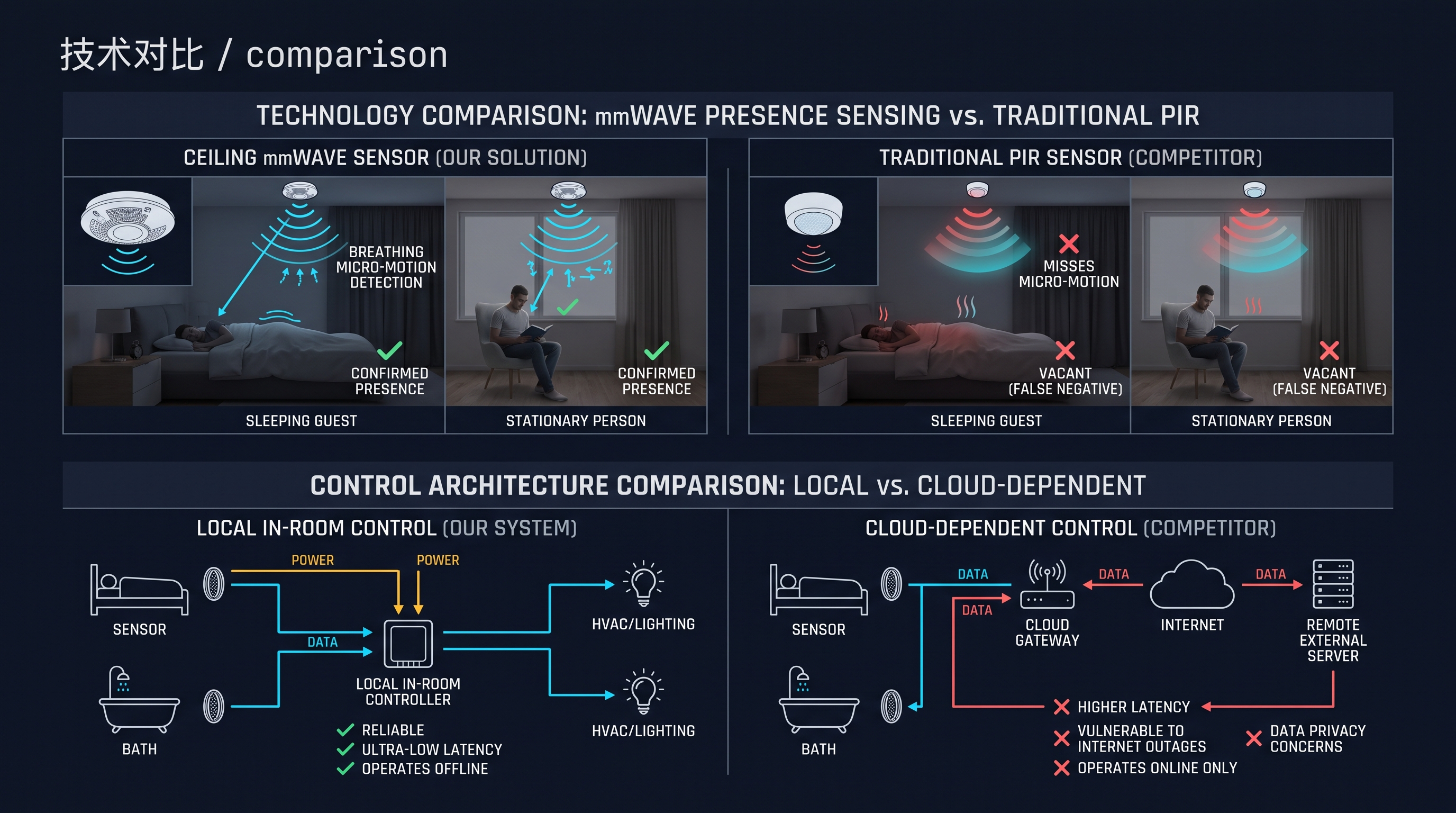
The 60GHz vs 24GHz mmWave sensors choice
The 60GHz vs 24GHz mmWave sensors decision comes down to detection range for a still person. A 24GHz mmWave sensor detects micro-motion such as breathing at about 2.5m, which covers a bed and seating area from a standard ceiling height. A 60GHz mmWave sensor extends micro-motion detection to about 5m, covering a king-size bed plus a seating area, or a junior suite, from one ceiling unit. In the 60GHz vs 24GHz mmWave sensors comparison, neither is "better" universally — the 60GHz unit wins on range, while the 24GHz unit wins on cost and power for standard rooms. Hotels with mixed room types often deploy 24GHz mmWave sensors in standard rooms and 60GHz mmWave sensors in suites and lobbies. The 60GHz technology operates in the 57-64GHz band with up to 7GHz bandwidth, enabling superior micro-motion resolution, while 24GHz sensors use the 24-24.25GHz ISM band with 250MHz bandwidth. This bandwidth difference enables 60GHz sensors to detect breathing micro-motion at superior accuracy compared to 24GHz units.
Why 60GHz mmWave sensors reach farther micro-motion
A mmWave sensor detects micro-motion by measuring tiny Doppler shifts from breathing and heartbeat. A 60GHz mmWave sensor uses a wider bandwidth than a 24GHz unit, so it resolves smaller displacements at greater distance — that is why a 60GHz mmWave sensor reaches 5m micro-motion while a 24GHz mmWave sensor reaches 2.5m. Both detect a sleeping guest where PIR fails, but the 60GHz vs 24GHz mmWave sensors range gap matters for larger rooms. Most mmWave radar occupancy sensors on the market detect micro-motion at only 1.5m or less — too short to cover a bed from a standard ceiling height — so both 24GHz and 60GHz wideband mmWave sensors outperform narrowband competitors. For hotels in tropical and desert climates, either mmWave sensor performs consistently across seasons because radar is unaffected by ambient temperature.
60GHz vs 24GHz mmWave sensors specification table
| Parameter | 60GHz mmWave sensor | 24GHz mmWave sensor |
|---|---|---|
| Frequency band | 60GHz (wideband) | 24GHz (wideband) |
| Max motion detection | 12m | 10m |
| Micro-motion / static detection | 5m | 2.5m |
| Breathing detection | Supported | Supported |
| Typical room coverage | Suite, lobby | Standard room |
| Detection angle | 120° | 120° |
The 60GHz vs 24GHz mmWave sensors table shows the 60GHz unit covers a larger area per device, reducing sensor count on big floors. The 120° field of view provides full coverage when either mmWave sensor is ceiling-mounted. A PIR sensor typically loses accuracy against reflective surfaces and in warm rooms, whereas a wideband mmWave sensor of either frequency resists interference from other 5.8GHz devices common in dense hotel deployments. For specifiers choosing between 60GHz vs 24GHz mmWave sensors, the decision is room-size-driven.
How 60GHz vs 24GHz mmWave sensors affect energy saving
Hotels typically cut room energy cost 20–40% with true occupancy-based control, because a mmWave sensor reacts to actual departure within seconds rather than guessing with a timer. When the 60GHz vs 24GHz mmWave sensors range is matched to room size, fewer nuisance triggers and fewer coverage gaps mean steadier savings. A 60GHz mmWave sensor covering a suite from one unit avoids the blind spots that would otherwise keep HVAC running in an uncovered corner. A 24GHz mmWave sensor covering a standard room at lower cost delivers the same 20–40% saving without overspending on bandwidth. The combination of a ceiling mmWave sensor and a recessed door contact sensor gives the building both instant entry detection and sustained occupancy detection regardless of frequency.
Choosing between 60GHz vs 24GHz mmWave sensors
Choosing between 60GHz vs 24GHz mmWave sensors comes down to room size, budget, and scalbility. A 60GHz mmWave sensor answers the suite-and-lobby need with 5m micro-motion and 12m motion; a 24GHz mmWave sensor answers the standard-room need at lower cost with 2.5m micro-motion and 10m motion. Both use Zigbee 3.0 mesh for building-scale reliability and drop into existing smart-building stacks without lock-in. Whether the project is a new hotel or a retrofit across mixed room types, a mmWave sensor built on wideband radar is the reference choice for occupancy accuracy. The mmWave sensor is the core of any guest-room automation deployment, and the 60GHz version is built for scale.
Certifications and export
CE, FCC, and RoHS certified for direct import into EU and US markets — every mmWave sensor ships with compliance documents. ISO 9001 manufacturing ensures each mmWave sensor meets consistent quality. Samples ship in 7–10 days; mass production runs 20–30 days with FOB Shenzhen, CIF, or DDP logistics. OEM branding and protocol customization are available at MOQ.
Not sure which sensor fits your project?
Talk to our mmWave application engineers for a free consultation.
Find the right presence sensor for your hotel project
Compare the 3 protocols, check hotel-specific case studies, and download the installation guide
Related solutions
3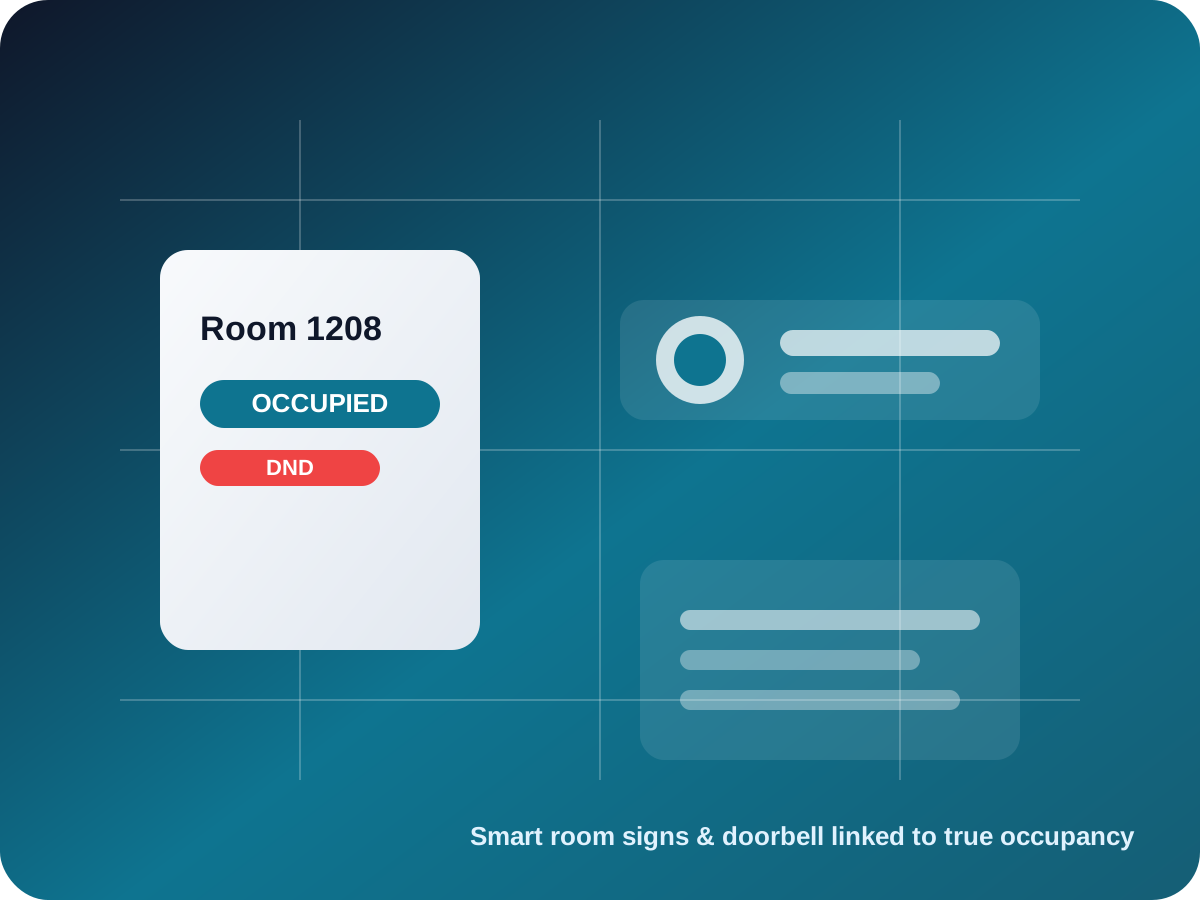
Hotel Energy Management — Occupancy Sensor HVAC & Lighting Control
Hotel energy management that uses an occupancy sensor to drive HVAC and lighting setback the moment a guest leaves. Our energy management system for hotels cuts room energy cost 20-40% with true occupancy detection.
It supports the same product context: hotel-room-occupancy-sensor.
Hotel Housekeeping Electronic DND System — Room Status Indicator
A hotel housekeeping electronic DND system links mmWave occupancy and a door sensor to show live room status. Our hotel do not disturb system replaces physical tags with true occupancy-driven room status signs.
It supports the same product context: hotel-room-occupancy-sensor.
Hotel Room Occupancy System — Intelligent Room Occupancy Management
A hotel room occupancy system that turns mmWave radar presence into live room status, housekeeping signals, and HVAC energy saving. Our intelligent room occupancy system manages guest rooms from one mmWave sensor mesh.
It supports the same product context: hotel-room-occupancy-sensor.
Related blog posts
3
Hotel Energy Savings vs Consumption Analysis
Compare hotel energy consumption patterns with achievable savings through occupancy-based automation and smart HVAC control systems for hotels.
It supports the same product context: ceiling-mmwave-occupancy-sensor, hotel-room-occupancy-sensor.
Hotel Guest Experience Optimization Guide
Optimize hotel guest experience with occupancy sensors through automated comfort control, seamless service delivery, and personalized room environments.
It supports the same product context: hotel-room-occupancy-sensor, ceiling-mmwave-occupancy-sensor.
Hotel Occupancy Sensor ROI Calculator Guide
Calculate hotel occupancy sensor ROI including energy savings, implementation costs, payback periods, and total cost of ownership analysis for hotels.
It supports the same product context: ceiling-mmwave-occupancy-sensor, hotel-room-occupancy-sensor.
Specify your hotel project with our engineers
Send your room count, ceiling type, and protocol preference. We will return a sample plan and quote within 24 business hours.
- Move from general guidance into a product or application discussion.
- Use RFQ when pricing, drawings, MOQ, or launch timing needs structure.
- Keep a direct contact path visible for fast clarifications and handoff.