Guest Room Occupancy Energy Management System
A guest room occupancy energy management system links ceiling mmWave presence to the thermostat and lighting so the HVAC runs only in truly occupied rooms.
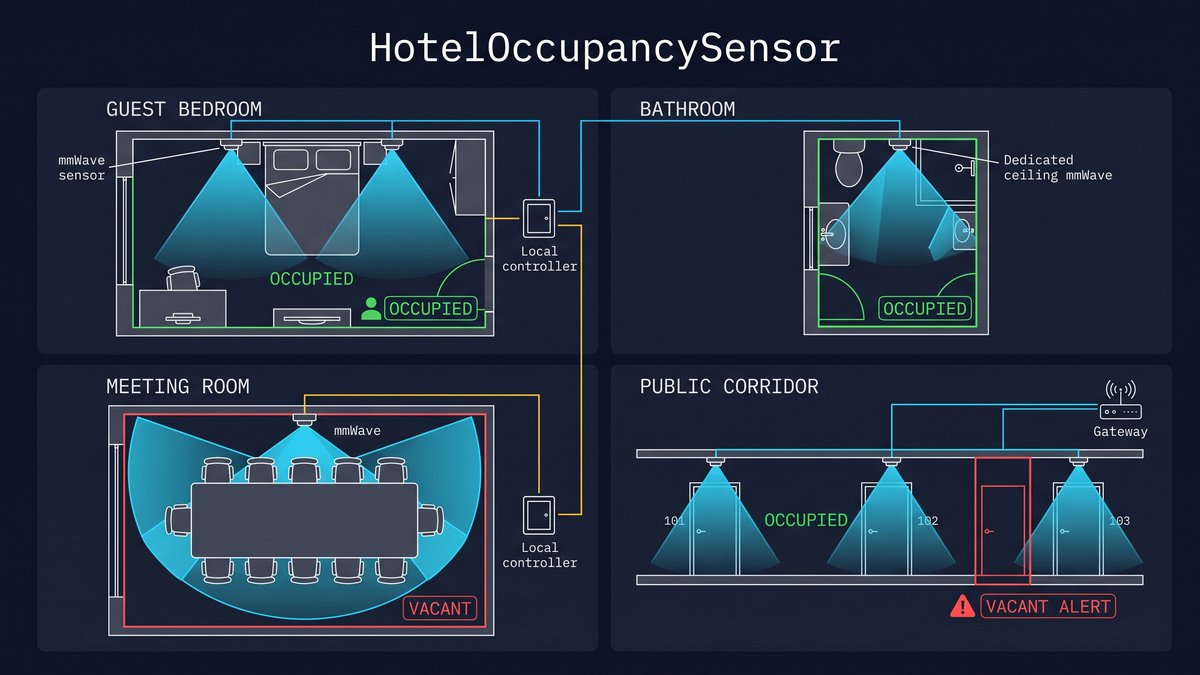
What guest room occupancy energy management is
Guest room occupancy energy management is the method of running a hotel room's heating, cooling and lighting according to whether the room is actually occupied, using a presence sensor in the room that talks to the thermostat rather than leaving the HVAC on a fixed schedule. The sensing layer is a ceiling-mounted mmWave radar that detects a still guest by breathing micro-motion, and the control layer is the thermostat, relay panel or room gateway that switches the space to a comfort setpoint when presence is confirmed and to an energy-saving setback when the room is vacant. A guest room occupancy energy management system differs from a plain energy-management device because the occupancy truth, not a timer, decides the mode. Where human flow rules a room, a PIR movement detector is unreliable because a seated or sleeping guest produces no motion, so the room may cool an empty space all evening or drop a quiet occupant out of comfort. A full system removes that ambiguity by distinguishing true presence from movement, which lets the energy controller act on the real state of the room. For a hotel owner the outcome is lower electricity spend on the air-conditioning, the largest guest-room load, without sacrificing the guest setpoint when the occupant is in the room.
How the occupancy signal drives the energy controller
In guest room occupancy energy management the path from sensor to saving is a short digital chain. The ceiling mmWave sensor detects presence and absence and outputs a low-voltage occupancy state to the room's thermostat or relay. The controller maps that state to a control mode: occupied rooms hold the guest setpoint, and vacant rooms step to a setback temperature and switch off the lighting after a timer. The same signal can be shared by the room's energy gateway, which aggregates every room in the property and records run hours for reporting. Because the sensor reads stillness rather than movement, the control state does not drop the moment the guest sits or lies down, which is the failure mode of a PIR scheme. When the guest returns, micro-motion is detected at the door zone and the controller brings the room back to the guest setpoint before the door fully opens. A robust guest room occupancy energy management setup keeps the control hysteresis short enough to react to re-entry quickly, yet long enough that a brief absence does not swing the room between modes, and it allows per-floor configuration of the setback depth so large rooms save more and small rooms stay gentle.
The energy-saving mode of the room
The energy-saving mode is where guest room occupancy energy management earns its keep. In occupied mode the thermostat holds the guest setpoint and the lighting runs normally. In vacant mode the controller applies a setback to the air-conditioning and turns off the lighting, resumed only by the presence signal. The setback is typically set a few degrees away from the guest setpoint in the cooling or heating direction, which is large enough to save but small enough that returning to comfort is fast. A hotel room is empty for a meaningful share of the day between checkout, guest outings, and housekeeping, and each of those empty hours is currently charged to the power bill at the guest setpoint. Guest room occupancy energy management converts those hours to a lower-load setback, so the run time of the compressor or the heating element falls in proportion to the empty time. The lighting is controlled on the same signal, which removes the wasted lit-but-unoccupied room that happens when a housekeeper leaves a light on or a guest forgets the bathroom light. Because the control is occupancy-driven rather than schedule-driven, the saving adapts to the actual rhythm of the building, and a room that stays empty longer saves more automatically.
Sensors used in the room control mix
Guest room occupancy energy management can fuse several sensors, but the mmWave ceiling radar is the anchor because it alone identifies a still person. A door switch or a card switch adds a strong occupancy hint on arrival, a PIR detector adds a movement check near the entrance, and a thermostat's internal temperature shows whether the space is being conditioned. In practice the system uses the mmWave presence reading as the authoritative state, and the door or card signals only corroborate arrival, because the mmWave unit keeps working when the guest is still. The choice of mmWave frequency shapes reach: a 24GHz sensor detects micro-motion to about 2.5m, suitable for most rooms, while a 60GHz sensor reaches about five metres to cover a suite or an open alcove. When each room carries one ceiling sensor and the thermostat accepts a standard occupancy input, guest room occupancy energy management adds minimal hardware to the existing room control, and the installer configures the sensor's reach, heartbeat time and output on the first floor before replicating the setting across the property.
Retrofitting existing rooms to the system
Retrofitting existing rooms into guest room occupancy energy management is a low-touch job because the sensor sits above the ceiling and only needs presence data and power from the room's wiring. The installer mounts one ceiling mmWave module, runs a low-voltage cable to the thermostat or relay panel, and the room's existing controller takes over the setback logic with no guest-facing wall work. Rooms built before connectivity usually still have space in the ceiling plenum and a reachable control device, so the retrofit does not disturb the occupied schedule. The main attention goes to placing the radar clear of the return-air grille and the bathroom exhaust fan, because air movement in front of the face can look like occupancy and hold a vacant room at the setpoint. A clean offset mount keeps the reading stable across the season. When a room already has a card switch or a PIR, the new presence sensor can be wired in parallel or through the gateway to supersede the older signal, and the treated rooms integrate with the front-desk system once the energy gateway aggregates them.
Costs and the return on the installation
The return on guest room occupancy energy management is easiest to estimate per room. The hardware cost is a low per-room figure in a bulk retrofit, installation is a short ceiling-mount and a single cable run, and the recurring expense is only the small idle power of the sensing module, which the saving dwarfs. The saving side is the share of the day each room sits empty at the guest setpoint; moving those hours to setback lowers the air-conditioning run time in proportion. Thinking of it per room, a standard hotel room is empty for several hours daily, and across a property of a hundred rooms the repeating reduction in HVAC runtime is the payback driver. Operators recommend a pilot floor first: measure the run hours before and after the retrofit to see real savings on the building's own pattern, then roll out to the remaining floors. Guest room occupancy energy management also improves the guest experience, because accurate presence avoids over-cooling after early arrival and keeps lighting from switching off on a still guest, which supports both the power bill and the satisfaction score.
Rolling the system out across a property
Rolling out guest room occupancy energy management at scale is a project of standards and verification. A specification fixes the sensor model, mounting distance, setback profile and output protocol so every room behaves identically. The operator pilots one floor, validates the before-and-after run-hour saving, and replicates the proven configuration to the rest of the property. A central energy dashboard collects occupancy and run hours from every room, which flags a sensor stuck reading occupied for inspection and a sensor reading vacant too often for recommissioning. The same room-occupancy truth serves housekeeping, since a room vacant for a set time can be serviced without a knock, and the front desk uses it for pre-conditioning and inventory. Keeping per-room documentation of the sensor serial, the wiring and the configuration means maintenance and a later phase of rollout copy the working setup without re-engineering.
How the system decides a room is vacant
The decision that makes guest room occupancy energy management accurate is how the system tells a vacant room from one with a still occupant. The ceiling mmWave sensor applies a presence classifier that looks for sustained breathing micro-motion rather than a single event, so a guest sitting quietly or asleep continues to read as occupied. Vacancy is declared only after the micro-motion pattern has been absent for a sustained interval, which prevents a door swing, a curtain, or a draft from holding a room in the occupied setpoint. The length of that absence is the vacancy timeout, and it balances two risks: too short a timeout can send the room into setback on a quiet guest, and too long a timeout can keep an empty room at the setpoint and forfeit the saving. In strong guest room occupancy energy management the timeout is configurable per floor so the operator tightens it in high-turnover rooms and relaxes it in suites where guests stay still for longer. The same classifier distinguishes a small person in a bed from a passing draft, because the reading is a repeatable breathing rhythm rather than an instantaneous edge.
Where the thermostat and the gateway sit in the chain
The architecture of guest room occupancy energy management separates the sensing from the control so that either can be upgraded without replacing the other. At the top of the chain is the ceiling mmWave sensor, which owns the occupancy truth. Below it sits the room's control device, the thermostat or a relay panel, which owns the temperature and the on-off control and consumes the occupancy signal. A room gateway, where present, aggregates several rooms onto one low-voltage or network bus and feeds the data to a central energy dashboard. This separation is what makes a retrofit economical: a property that already has a workable thermostat only adds the sensor and the connecting wire, and a property that later upgrades the thermostat keeps the same sensor and the same wiring, because the interface between them is a standard occupancy input. When both ends speak a common protocol, guest room occupancy energy management scales from a pilot floor to a full building without redesigning the room wiring, and a central platform can compare buildings on the same run-hour numbers.
Energy measures beyond the heating and cooling
Guest room occupancy energy management is not limited to the air-conditioning, because the same occupancy truth drives a handful of other loads in the room. The ceiling sensor's vacant state turns off the bedroom and bathroom lighting after a short delay, which removes the wasted capacity of a light left on by a guest or a housekeeper. In rooms with a controllable plug load, the system can cut the standby power of televisions and chargers once the room reports vacant. Where the bathroom extractor fan is wired to the occupancy signal, it runs only while the room is occupied and stops instead of cycling through empty hours. Each of these adds a smaller but real reduction on top of the HVAC saving, and because they all come from one sensor they add no new hardware. A comprehensive guest room occupancy energy management deployment therefore stacks lighting, plug-load and extractor control on the same presence reading, which lifts the total saving without complicating the wiring or the configuration of the room.
Choosing the right sensor type for the room
The sensor choice in guest room occupancy energy management is decided by the reach and the false-trigger behaviour a room demands. A 24GHz ceiling mmWave sensor detects breathing micro-motion to about 2.5 metres, which covers the bed and seating area of a standard room from the ceiling point, and it is the low-cost default for most guest floors. A 60GHz wideband sensor reaches about five metres and adds finer micro-motion resolution, which suits a suite, a junior suite, or an open alcove where a single unit must cover more floor. Both output a standard occupied-vacant signal to the thermostat, so swapping the sensor to fit a larger room does not change the control wiring. The false-trigger specification matters as much as reach: a unit that reads a curtain or a draft as occupancy holds an empty room at the setpoint, while a unit with a proper stillness classifier keeps the state honest. By matching reach to the largest room and the classifier to the ventilation layout, a property keeps guest room occupancy energy management consistent across every room type it operates.
Commissioning the system for first use
Commissioning is where guest room occupancy energy management is taken from wiring into working control, and it follows a short checklist per room. The installer confirms the ceiling sensor sees the occupied floor and is clear of the return-air grille and the bathroom exhaust. The sensor is powered, and its occupancy output is verified at the thermostat or the gateway terminal. The commissioning configures the detection reach to the room's geometry and sets the vacancy timeout to the operator's preference. A walk test then proves the sequence: entering the room flips the reading to occupied, remaining still keeps it occupied for the configured hold, and leaving flips it to vacant after the timeout. The same four steps are repeated on every room and the settings are recorded in the room's documation. A well-commissioned room behaves predictably from the first night, and a proper commissioning record gives maintenance a fast reference when a later report flags a sensor that reads wrong.
The dashboard and monitoring the saving
Guest room occupancy energy management is only trustworthy once the saving can be seen, and that is the job of the central dashboard. The energy gateway or platform collects the occupancy state and the run hours from every room, and reports the occupied and vacant time so the property can see how much of the day the setbacks actually ran. A room that reads permanently occupied shows up as a sensor to recommission, because it is silently holding that room at the setpoint. A room that reads vacant too often shows up as a comfort risk, because an occupant may be getting a setback they did not expect. The dashboard compares floors and buildings on the same run-hour metric, which turns guest room occupancy energy management into a measurable operation rather than a claim. Over a season these run-hour numbers give the property the before-and-after evidence to confirm the payback and to tune the setback and timeout settings to the actual rhythm of the building instead of a default profile.
Common mistakes when deploying the system
Avoiding a few common mistakes keeps guest room occupancy energy management effective. Mounting the sensor directly over the return-air grille is the most frequent error, because the air movement in front of the radar face is read as presence and an empty room stays at the setpoint. Setting the vacancy timeout too short drops a still guest into a cold setback, while too long forfeits the empty-period saving, so the balance must be tuned per floor. Wiring the sensor to the wrong control terminal, or to a thermostat that does not accept a standard occupancy input, makes the sensor blind and keeps the room at the setpoint all day. Skipping the room documentation means a later fault cannot be traced to its configuration. And rolling out one floor without measuring the before-and-after run hours removes the evidence that justifies the wider deployment. Each of these is avoided by a standards-based install, a brief commissioning pass per room, and a dashboard that flags a sensor reading wrong, which together keep the operation saving reliably.
The role of the front desk in the operation
Guest room occupancy energy management reaches its full value when the front desk uses the same occupancy truth the energy controller does. A room that has reported vacant for a set time can be handed to housekeeping for cleaning without a knock, which speeds the turn and improves the guest's peace. A confirmed reservation and a vacant room can be pre-conditioned just enough ahead of arrival, so the space is comfortable but is not heated or cooled all day waiting. A room that stays vacant across the afternoon can be released from the energy controller earlier and returned to the setpoint only when the next booking is confirmed. Because the front desk and the energy system read the same signal, the property avoids the waste of conditioning a room that is not going to be sold and the risk of presenting a cold room to a late arrival. In this way guest room occupancy energy management becomes part of daily operations rather than a separate energy project, and the same data supports both the power bill and the pace of room turnover.
Where energy management is heading in hotels
The forward path for guest room occupancy energy management is to fuse the presence reading with the rest of the hotel's systems rather than to build a larger sensor. The ceiling sensor will share its truth with the door-lock, the reservation, and the housekeeping queue, so the room is pre-conditioned for a confirmed guest and set back the moment it is released. The same presence signal will join smart-lighting scenes and per-guest climate profiles, and a central energy platform will compare buildings by run-hour efficiency. Because the sensing and control talk a standard occupancy protocol, a property that deploys guest room occupancy energy management now keeps that investment when the thermostat or the platform is upgraded, and the wiring and the sensor carry over without rework. For an owner the value compounds: the room saves every day it spends vacant hours at setback, the data makes operations sharper, and the same standard interface positions the property for the next generation of connected room control.
Not sure which sensor fits your project?
Talk to our mmWave application engineers for a free consultation.
Find the right presence sensor for your hotel project
Compare the 3 protocols, check hotel-specific case studies, and download the installation guide
Related blog posts
3
Hotel Room Occupancy Sensing Solution for Energy Savings
A hotel room occupancy sensing solution uses ceiling mmWave sensors to run HVAC and lights only when a room is truly occupied. A guide for owners.
It supports the same product context: ceiling-mmwave-occupancy-sensor.
How Do Hotel Thermostats Detect Occupancy in a Room?
How do hotel thermostats detect occupancy: a ceiling mmWave sensor or a PIR reads presence and drives the AC, while a door switch or card adds a hint.
It supports the same product context: ceiling-mmwave-occupancy-sensor, hotel-occupancy-sensor.
How Hotel Occupancy Sensors Work in a Guest Room
How hotel occupancy sensors work: a ceiling mmWave reads a still guest by breathing micro-motion and tells the thermostat whether to cool the guest room.
It supports the same product context: ceiling-mmwave-occupancy-sensor.
Specify your hotel project with our engineers
Send your room count, ceiling type, and protocol preference. We will return a sample plan and quote within 24 business hours.
- Move from general guidance into a product or application discussion.
- Use RFQ when pricing, drawings, MOQ, or launch timing needs structure.
- Keep a direct contact path visible for fast clarifications and handoff.