How Hotel Occupancy Sensors Work in a Guest Room
How hotel occupancy sensors work: a ceiling mmWave reads a still guest by breathing micro-motion and tells the thermostat whether to cool the guest room.
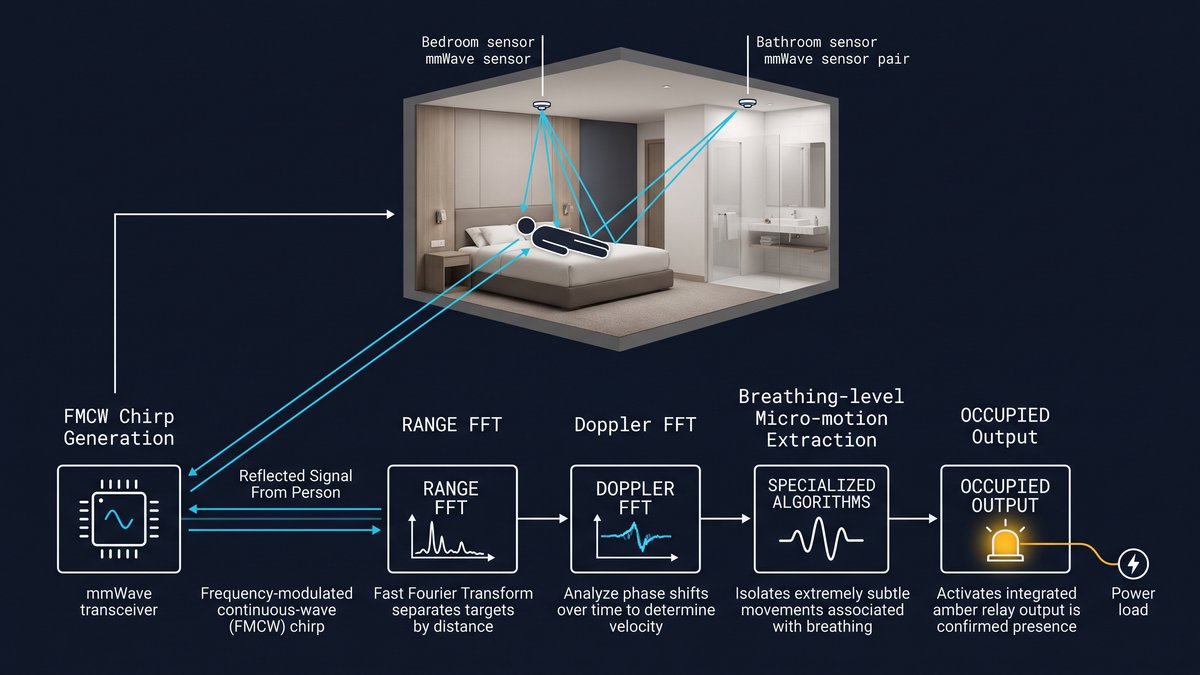
How hotel occupancy sensors work in a nutshell
How hotel occupancy sensors work in a guest room comes down to a radio signal and a moving chest. A ceiling-mounted sensor sends out short radar pulses and measures the return, and when it reads the micro-motion of a person breathing, it declares the room occupied. That is the difference from a motion detector: how hotel occupancy sensors work is by detecting stillness as presence, so a sleeping guest, a guest reading in a chair or a guest in a quiet meeting still counts as occupied. The sensor in a hotel is usually a mmWave radar operating in a licensed or ISM band, and it resolves very small movement of the chest wall at several metres. The unit outputs a simple occupied or vacant signal to the room's thermostat, which then decides whether to cool or heat at the guest setpoint or to step into an energy-saving setback. How hotel occupancy sensors work is therefore a chain of three ideas: emit a radar signal, classify whether a human is present even when still, and hand that occupancy truth to the controller that runs the room's energy. This is why a well-chosen sensor improves both comfort and the power bill without any interaction from the guest.
The radar principle behind the sensor
The radar principle behind how hotel occupancy sensors work is that a mmWave signal reflects off the body and returns with a tiny frequency or phase shift when the body moves. The sensor's transmitter radiates a continuous or pulsed signal in the 24GHz or 60GHz band, and the receiver measures the reflected wave. A person's chest rises and falls with each breath, so the reflected signal is modulated by that micro-motion even when the person is otherwise still. The sensor processes that modulation and distinguishes human breathing from a change that is not a human, such as a slowly moving curtain, a draft, or a swinging door. A 24GHz sensor typically reads this respiratory micro-motion to about 2.5 metres, while a 60GHz wideband sensor extends it to about five metres and offers finer resolution. This is the property that makes a sensor in a hotel superior to a PIR, which sees only large displacement and goes inactive the instant the occupant is still. How hotel occupancy sensors work therefore hinges on classifying the faint, rhythmic signature of breathing, not on waiting for a person to swing an arm.
How the sensor sees a still guest
The part of how hotel occupancy sensors work that people find surprising is that a stationary guest is the easiest case, not the hardest. Once the radar has locked onto the chest micro-motion, the steady breathing creates a repeating pattern that the sensor recognizes reliably and reports as presence. This is what keeps the room at a comfortable setpoint through the night while the guest sleeps. With a PIR-style device, the same quiet guest produces no trigger, so the room drifts into setback and the guest wakes cold; a mmWave sensor avoids that because the breathing signature is always present. The sensor applies a confidence threshold so one edge, a momentary draft or a door swing, does not flip the state. When the person leaves, the breathing pattern disappears for a sustained period and the sensor declares vacancy, which the thermostat uses to enter setback and save energy until the guest returns and re-triggers on entry movement or renewed micro-motion. The result is that how hotel occupancy sensors work makes presence reliable across every state a guest can be in, from active movement to deep sleep, which is exactly the reliability a room energy controller needs.
The signal the sensor hands to the thermostat
The output stage of how hotel occupancy sensors work joins the sensor to the room's energy control. The mmWave unit produces a low-voltage occupancy signal, normally a relay contact or a digital line, that reads occupied or vacant. This output connects to the thermostat, a relay panel, or a room energy gateway that carries the control logic. When the signal reads occupied, the thermostat holds the guest setpoint and the lighting stays on. When it reads vacant, the thermostat steps to a setback temperature and the lighting switches off after a short timer, resumed on re-entry. Because the output is a standard occupancy input, the sensor fits mainstream thermostats and existing hotel room control panels without a proprietary gateway. The commissioning step sets the detection reach to the room's geometry and the vacancy delay to the operator's preference so brief absences do not bounce the mode. After that, how hotel occupancy sensors work becomes invisible to the guest: the room reacts correctly whether they are out for the day, asleep, or arriving back late, and the controller does the energy work it was built for.
What the sensor does differently from a motion detector
The clearest way to see how hotel occupancy sensors work is to compare it with a motion detector. A PIR motion detector reacts to a change in infrared energy as a warm body moves across its zones; a still person produces no change, so the detector reports no motion and the controller cannot tell whether the room is occupied. In a hotel this is a real flaw, because guests spend much of their time still, reading, working or sleeping. The mmWave occupancy sensor instead detects the chest micro-motion, so it keeps reporting presence while the guest is still. How hotel occupancy sensors work also differs in reach and placement: the ceiling mmWave unit covers the full floor and sees the bed and seating area, while a wall PIR often has a narrower pattern. The trade-offs are cost and range, where a 24GHz unit suits a standard room and a 60GHz unit suits a larger space. When a project compares the two, the deciding factor is false-trigger behaviour and the ability to hold occupancy on a quiet guest, which is precisely the behaviour that keeps the room comfortable and the energy bill low.
Wiring and installation in a room
How hotel occupancy sensors work in an installed room depends on two connections: power and occupancy output. The ceiling sensor takes low-voltage DC power, usually drawn from the lighting or control circuit, and it outputs the occupied or vacant state to the thermostat or gateway. Because both lines sit above the ceiling, the installer runs a single low-voltage cable from the sensor to the control device and leaves the guest-facing wall untouched. The mounting point matters for accuracy: the sensor should face the main occupied floor and sit clear of the return-air grille and the bathroom exhaust vent, because moving air in front of the radar face can register as a false trigger. Commissioning sets the device's distance threshold and the vacancy timeout, and a quick walk test confirms the room changes state when a person enters, stays occupied while still, and reads vacant after they leave. Once set, how hotel occupancy sensors work is maintenance-free beyond an occasional cleaning of the lens, and the same configuration replicates across a floor with consistent results.
Energy and comfort outcomes in a guest room
The measurable outcome of how hotel occupancy sensors work is in the room's comfort and its power use. Because the sensor holds occupied state while a guest is still, the thermostat never drops a sleeping guest into setback, which protects the satisfaction score. Because it reads vacancy reliably when the room is empty, the controller enters setback for the many hours a room sits unused, cutting the run time of the air-conditioning and the lighting on those vacant hours. The saving is driven by the share of the day the room is empty and the setpoint distance of the setback, and it compounds across a whole property of rooms. Hotels that deploy a ceiling mmWave sensor typically pilot one floor to measure the before-and-after run hours and then scale the proven setting, because the repeatable behaviour in one room is what makes the outcome predictable in the next.
The difference between presence and motion
The single idea that separates an occupancy sensor from a motion detector is the difference between presence and motion, and it decides how hotel occupancy sensors work in practice. Motion is a change in the environment produced by a body moving across a zone; presence is the ongoing fact that a person is in the room, moving or not. A PIR motion detector reacts to motion only, so it stops reporting a person who is sitting still, reading, or asleep. A mmWave presence sensor detects the fine micro-motion of the chest that never stops while a person lives, so it continues to report presence even when the guest is completely still. This is why the two devices behave so differently in the same room: the motion detector goes quiet on a still guest and the presence sensor holds steady. How hotel occupancy sensors work well therefore hangs on whether the device is built to sense motion or built to sense presence, and a room's thermostat needs presence, since most of a guest's time is spent still.
Why the vacuum timeout matters
The vacancy timeout is one of the settings that decides how hotel occupancy sensors work in a comfortable way. After the sensor reads vacant, it waits a set interval before the controller enters setback, and that interval is the balance between comfort and saving. If the timeout is too short, a guest who walks into the bathroom or steps into the corridor briefly can come back to find the room already settling into setback. If the timeout is too long, an empty room keeps running at the setpoint and the saving for those empty hours is lost. Most installations set a short delay, long enough that a real guest is not dropped, and then let the setback run as long as the room stays vacant. Because how hotel occupancy sensors work at the edge of the room depends on this one number, the operator tunes it per floor or per room type rather than leaving a single global default. A suite, where guests often stay still for long stretches, may use a longer timeout, while a high-turnover standard room may use a shorter one.
How the sensor separates noise from a person
A useful ceiling sensor must decide whether the moving shape it senses is a person or ambient noise, and that separation is the hardest part of how hotel occupancy sensors work. Curtains that ripple from a vent, a towel that sways near the radar, a door swinging in the corridor, and the exhaust fan all produce movement in the room. The sensor distinguishes a person by the regularity and location of the signal: breathing micro-motion comes from a single location near the expected body area and repeats at a steady rhythm, whereas airflow noise is diffuse and inconsistent. The device applies a classifier that requires a sustained presence signature before it reports occupied, and it requires the absence of that signature for a sustained period before it reports vacant. This gives the controller a stable state instead of a twitchy one. Understanding how hotel occupancy sensors work at this level helps a property choose a unit with a strong classifier, since a cheap unit that flags every curtain keeps a vacant room at the setpoint and forfeits the saving that the sensor was bought to deliver.
How the sensor is powered and wired
The power and wiring add a practical layer to how hotel occupancy sensors work in a real room. The ceiling sensor runs on low-voltage DC, normally 12V or 24V, drawn from the lighting circuit or a dedicated control transformer, and it needs only a single run of low-voltage cable to carry both power and the occupancy output down to the thermostat. Because the sensor and its wire both sit above the ceiling, the installation does not touch the guest-facing wall and the room stays in service. The occupancy output is usually a relay contact or a digital low-voltage line that the thermostat reads as occupied or vacant. This standard interface is what lets the same sensor work with several thermostat brands and with either a standalone room controller or a central gateway. How hotel occupancy sensors work from an installer's view is therefore a low-impact job: mount the sensor, run one wire, verify the input at the thermostat, and commission the reach and timeout.
The role of the thermostat in the chain
The thermostat is the actor that turns how hotel occupancy sensors work into a room that is comfortable and economical. The sensor reads presence and hands a state to the thermostat; the thermostat decides what to do with it. When the state is occupied, the thermostat holds the guest setpoint and keeps the fan and lighting running. When the state is vacant, the thermostat steps to a setback temperature and switches the lighting off after the vacancy timer. Because the thermostat holds this logic, the property can change the energy behaviour without changing the sensor, simply by editing the setback and timeout on the thermostat or the gateway. Conversely, a room can be upgraded to a new thermostat while the same sensor and wire carry over. This separation of sensing and control is the architectural reason why hotel occupancy sensors work as an economical retrofit: the property does not replace the whole room system, it adds the presence reading and lets the existing controller act on it.
What affects the detection reach
The reach of a sensor, and therefore how hotel occupancy sensors work across a floor, depends on the frequency band and the environment. A 24GHz sensor detects micro-motion such as breathing to about 2.5 metres, which fits a standard guest room and the bed and seating area under the ceiling point. A 60GHz wideband sensor extends micro-motion detection to about five metres, which covers a king-size bed plus a seating area or a junior suite from one unit, and its wider bandwidth gives a finer reading of the breathing signal. The environment affects reach as well: a low ceiling concentrates the room into range, while a tall lobby demands a longer-reach unit. Glass and thin partitions carry a radar signal fairly well, and a large open area needs a sensor with more reach or more units. When a property maps how hotel occupancy sensors work to its room sizes, it matches a 24GHz unit to standard rooms and a 60GHz unit to suites and open spaces, so each room is covered by one reliable reading.
Faults to watch during operation
Even a good sensor needs a little care, and knowing how hotel occupancy sensors work helps a property spot faults early. A sensor that reads occupied all day is the most costly fault, because it holds a vacant room at the setpoint and silently removes the saving; the dashboard should flag any room that never reports vacant for recommissioning. A sensor that reads vacant while someone is present is a comfort fault and usually comes from a timeout set too short or a mount facing the wrong part of the room. Dust on the lens can dull the reading, so an occasional wipe keeps the signal clean, and a steadily moving curtain near the face should be moved clear. Firmware on the gateway, where offered, should be kept current so behaviour stays consistent across floors. With these few checks, the presence reading stays accurate and the room keeps delivering the comfort and the saving that the sensor was installed to provide.
How the system scales across a hotel
Scaling how hotel occupancy sensors work from one room to an entire property is a matter of standards and evidence rather than more hardware. A specification fixes the sensor, the mounting point, the setback profile and the vacancy timeout so every room behaves the same. The operator pilots one floor, measures the run hours of the air-conditioning before and after, and uses the measured change to roll the profile to the rest of the building. A central dashboard collects occupancy and run-hour data per room, which lets maintenance flag and recommission a sensor that holds a room at the setpoint. Because the sensing and control share a standard interface, a later thermostat upgrade or a central energy platform carries the existing presence reading over without rewiring. Once one floor is proven, the same configuration reproduces the comfort and the saving in every following room, which is why a pilot-first rollout turns a working sensor into a property-wide system that is easy to run and easy to trust.
Checking the sensing is working
Verifying how hotel occupancy sensors work after an install is a short walk test that should be part of every commissioning. The technician enters the room and confirms the reading flips to occupied; they then remain still for the configured hold and confirm it stays occupied, which proves the presence, not motion, is being read; finally they leave and confirm the state flips to vacant after the vacancy timeout. The same three steps confirm the thermostat responds, so the room enters the setback profile when vacant and returns to the guest setpoint on re-entry. A room that fails any step is traced to the sensor mount, the reach setting, or the wiring to the thermostat before it is released. Because these checks are quick and repeatable, a property can audit a floor in minutes during commissioning and re-verify a sensor after maintenance. Keeping this walk test in the standard install process is what guarantees the comfort and the saving are actually delivered room by room, rather than assumed from a sensor that was simply powered up.
How the sensor reports to the building
The reporting layer of how hotel occupancy sensors work closes the loop with the building and the operator. The room gateway collects the occupied-vacant state and the run hours from each sensor and sends them to a central energy dashboard. The dashboard shows, per room and per floor, how long the room was occupied and how long it ran in the saving mode, which lets the property see the effect of the setback profile. A room that never reports vacant shows up as a candidate for recommissioning, because it is holding that room at the setpoint all day. A floor that saves more than another points to a tighter or better-fitting profile that can be copied. Because the same data flows to the front desk, a room vacant for a set time can be handed to housekeeping without a knock. This reporting is what makes how hotel occupancy sensors work an audited operation, where the saving is visible in the numbers rather than assumed.
Not sure which sensor fits your project?
Talk to our mmWave application engineers for a free consultation.
Find the right presence sensor for your hotel project
Compare the 3 protocols, check hotel-specific case studies, and download the installation guide
Related solutions
3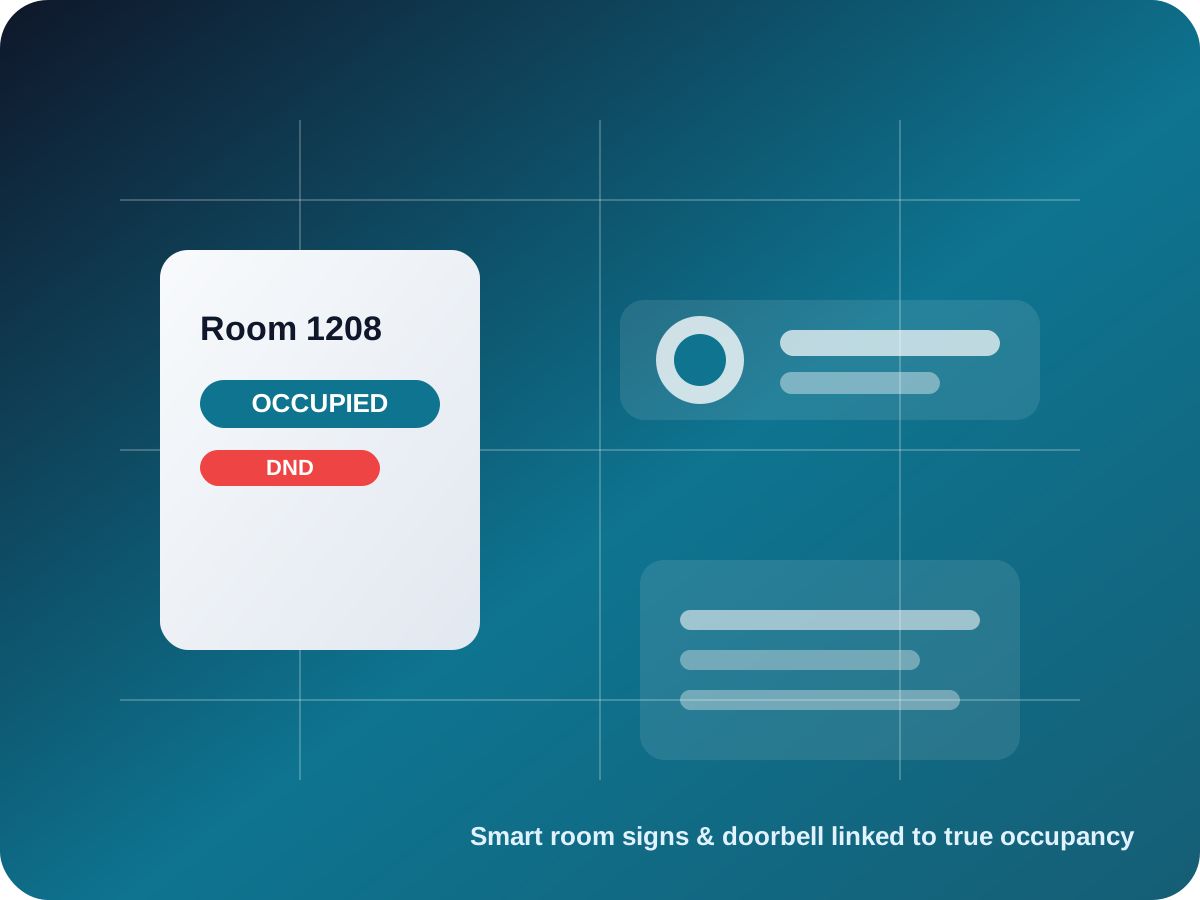
Hotel Energy Management — Occupancy Sensor HVAC & Lighting Control
Hotel energy management that uses an occupancy sensor to drive HVAC and lighting setback the moment a guest leaves. Our energy management system for hotels cuts room energy cost 20-40% with true occupancy detection.
It supports the same product context: hotel-room-occupancy-sensor.
Hotel Housekeeping Electronic DND System — Room Status Indicator
A hotel housekeeping electronic DND system links mmWave occupancy and a door sensor to show live room status. Our hotel do not disturb system replaces physical tags with true occupancy-driven room status signs.
It supports the same product context: hotel-room-occupancy-sensor.
Hotel Room Occupancy System — Intelligent Room Occupancy Management
A hotel room occupancy system that turns mmWave radar presence into live room status, housekeeping signals, and HVAC energy saving. Our intelligent room occupancy system manages guest rooms from one mmWave sensor mesh.
It supports the same product context: hotel-room-occupancy-sensor.
Related blog posts
3
Guest Room Occupancy Energy Management System
A guest room occupancy energy management system links ceiling mmWave presence to the thermostat and lighting so the HVAC runs only in truly occupied rooms.
It supports the same product context: ceiling-mmwave-occupancy-sensor.
Hotel Room Occupancy Sensing Solution for Energy Savings
A hotel room occupancy sensing solution uses ceiling mmWave sensors to run HVAC and lights only when a room is truly occupied. A guide for owners.
It supports the same product context: ceiling-mmwave-occupancy-sensor, hotel-room-occupancy-sensor.
How Do Hotel Thermostats Detect Occupancy in a Room?
How do hotel thermostats detect occupancy: a ceiling mmWave sensor or a PIR reads presence and drives the AC, while a door switch or card adds a hint.
It supports the same product context: ceiling-mmwave-occupancy-sensor.
Specify your hotel project with our engineers
Send your room count, ceiling type, and protocol preference. We will return a sample plan and quote within 24 business hours.
- Move from general guidance into a product or application discussion.
- Use RFQ when pricing, drawings, MOQ, or launch timing needs structure.
- Keep a direct contact path visible for fast clarifications and handoff.