How Do Hotel Thermostats Detect Occupancy in a Room?
How do hotel thermostats detect occupancy: a ceiling mmWave sensor or a PIR reads presence and drives the AC, while a door switch or card adds a hint.
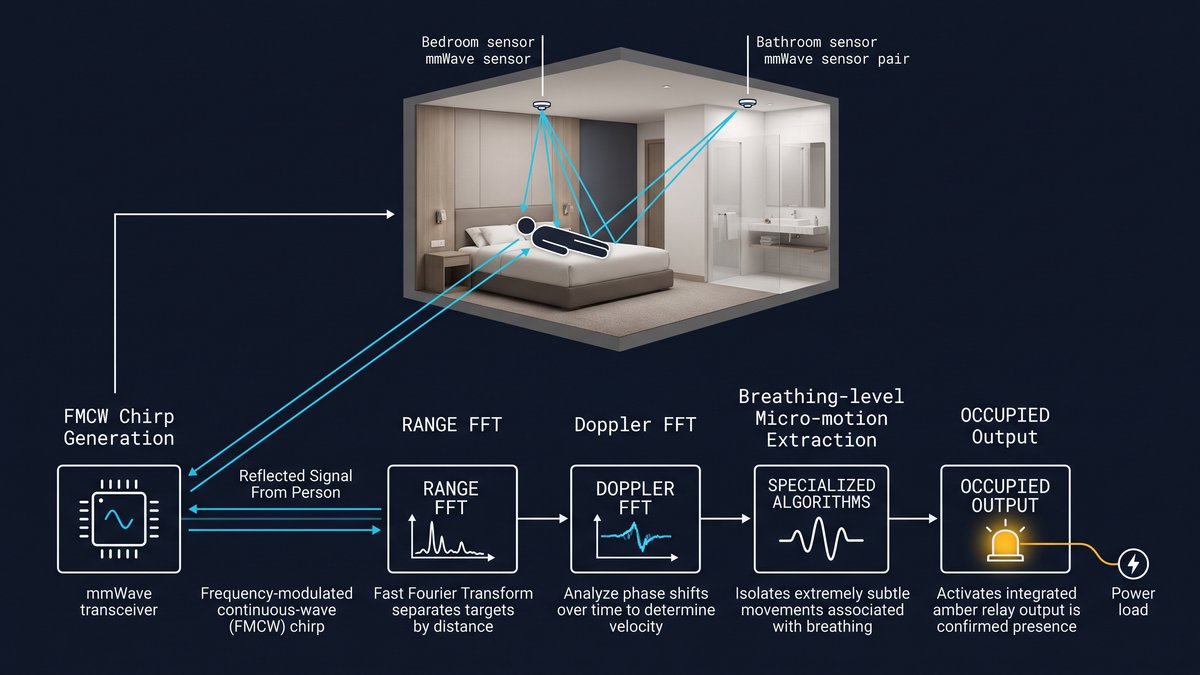
How do hotel thermostats detect occupancy in a guest room
How do hotel thermostats detect occupancy is a question most guests never need answered, but the method decides whether a room stays comfortable all night. In a modern hotel the thermostat reads occupancy from a sensor in the room, most often a ceiling-mounted unit that tells the control board whether a person is present. The cleanest answer to how do hotel thermostats detect occupancy is a mmWave presence sensor that sees respiratory micro-motion, so it still knows a guest is there when that guest is asleep or sitting still. An older or simpler room uses a PIR motion detector, which reacts only to movement and goes quiet the moment the guest is still, and a third set of rooms infers occupancy from a door switch or a card in the wall reader. Whatever the sensing method, the thermostat uses the occupied-vacant signal to hold the guest setpoint while someone is in the room and to step into an energy-saving setback when the room is empty. The method matters because a robust presence reading keeps the guest comfortable through the night, while a movement-only method can allow the room to drift out of the desired temperature on a still occupant.
How a ceiling mmWave sensor detects you
The mmWave method of answering how do hotel thermostats detect occupancy is the most accurate of the practical options. A ceiling sensor sends radar in the 24GHz or 60GHz band and reads the return from the room below. When a person breathes, the chest moves a little with every breath, and the sensor resolves that micro-motion even metres away. This is what lets the thermostat keep the setpoint while the guest sleeps, reads, or works quietly. A 24GHz unit typically sees this micro-motion to about 2.5 metres, enough for a standard room, and a 60GHz unit reaches about five metres to cover a suite. The sensor outputs a simple occupied or vacant signal to the thermostat, which then chooses the comfort mode or the setback. Because the reading does not depend on arm movement, the mmWave method avoids the embarrassing outcome of a motion-based system that drops a sleeping guest into a cold setback. It also avoids most false triggers from curtains or drafts by applying a stillness classifier that requires a sustained human signature rather than a single moving edge.
How PIR motion detection differs
The PIR answer to how do hotel thermostats detect occupancy is older and cheaper, but it has a blind spot. A passive infrared detector senses a change in heat as a warm body moves across its viewing zones, so it reports motion immediately on entry. The limitation is that a seated or sleeping guest makes no change in the infrared field, so the detector stops reporting presence and the thermostat may step the room into setback even though the guest is still inside. For that reason a room fitted only with PIR tends to use a long keeping timer, or it accepts that the guest may wake to a colder room. How do hotel thermostats detect occupancy with PIR is therefore reliable for entry and movement, and weaker for a quiet occupant, which is exactly where the mmWave sensor improves on it. Some rooms combine both, using the PIR for a fast initial trigger and the mmWave for sustained presence, but a well-chosen mmWave sensor alone already covers the whole occupancy state.
How door and card switches infer occupancy
The third way to answer how do hotel thermostats detect occupancy is through the door or the card. A card switch on the wall requires the guest to insert a key card for the power in the room, and it switches off the power when the card is removed, so the thermostat's occupancy hint follows the card rather than the person. Like everything card-based, this assumes the guest always uses the card, and guests sometimes leave a card in the reader all day or wedge it in place, which defeats the saving. A door switch senses whether the door is open or closed, which tells the system about the entrance but not about the person inside. Neither reads true presence, so both are better used as corroborating hints alongside a presence sensor than as the controller's only source of truth. In practice a room that pairs a card switch with a ceiling mmWave presence sensor gets an accurate picture: the card confirms arrival, the mmWave confirms the guest is physically present and still, and the thermostat acts on the combined state.
Why the detection method affects comfort
How do hotel thermostats detect occupancy affects guest comfort more than most travellers expect, because the method decides whether the room drifts away from the setpoint at the wrong moment. A presence-accurate room holds the temperature through the night while a guest sleeps, which is the experience guests notice most. A movement-only room, by contrast, can step into setback on a still guest and leave them to wake cold, or it can run a long timer to compensate and waste the saving. The energy-saving outcome depends on the same accuracy: a sensor that correctly reads vacancy sends the room into setback for the many empty hours, cutting the air-conditioning runtime without any guest noticing. So the detection method sits at the centre of both the comfort score and the power bill. When a property chooses a thermostat, comparing how do hotel thermostats detect occupancy across the options helps it pick a room that stays comfortable and a system that still saves energy in the long, quiet empty periods.
Checking what a room is likely using
Guests who wonder how do hotel thermostats detect occupancy can usually tell from the hardware. A small dome or puck on the ceiling over the bed area is either a mmWave presence sensor or a PIR and reads the room for occupancy. A wall panel with a slot for a card is a card switch and controls power by the card. Some rooms have both, and the ceiling unit does the presence sensing while the card adds the arrival hint. If a room stays at a steady temperature even when the guest is still for a long time, the sensing is likely presence-based rather than movement-based. The practical point for a guest is that modern thermostats use presence sensing to keep the room comfortable, and the system is designed to save energy only when the room is genuinely empty, so resting quietly in the room is exactly what the sensor expects.
Selecting a thermostat with the right sensing
For an owner, how do hotel thermostats detect occupancy is a selection criteria. The thermostat should accept a standard occupancy input from a ceiling mmWave sensor, so the property can use one sensing standard across rooms and retrofit the sensor without swapping every panel. The thermostat should expose a configurable setback and vacancy timeout, because those settings decide how much the empty hours save while keeping the occupied room comfortable. And the system should report per-room occupancy and run-hours to a dashboard, so maintenance can spot a sensor holding a room at setpoint and recommission it. Piloting a single floor, measuring the run hours before and after, and scaling the proven profile gives the property a thermostat system whose occupancy detection is reliable enough to turn the energy-saving mechanism into a measured, repeatable saving.
The three sensing methods compared
How do hotel thermostats detect occupancy is answered by comparing the three sensing methods side by side. A mmWave presence sensor reads a still person through breathing micro-motion, so it holds occupancy for a guest who is asleep or reading, and it is the most accurate of the three. A PIR motion detector reacts to movement, so it catches a guest on entry but goes quiet once the guest is still, which can let the room drift from the setpoint. A card switch or a door switch infers occupancy from the card or the door state rather than from the person, so it is fast on arrival but is fooled by a card left in the reader or a door propped open. In practice many hotel thermostats use one of these as the primary input and a second as a corroborating hint. The reliable baseline is the mmWave presence reading, because it does not depend on movement or on the guest obeying a card protocol, and it keeps the room at the setpoint through the quiet stretches that PIR and card systems miss.
Why a still guest tests the detection
The clearest test of how do hotel thermostats detect occupancy is a still guest, because a guest asleep or reading in a chair produces no gross motion. A PIR detector, which waits for a body to move across its zones, goes inactive at this point, and if the thermostat relies on it the room can step into setback while the guest is still inside, leaving them to wake cold. A card switch keeps the power on while the card is in the reader, but it turns off if the card is removed and tells nothing about where the guest is. Only the mmWave presence sensor reads the micro-motion of breathing, so it reports occupied throughout the still period and the thermostat holds the setpoint. This is the practical reason hotels that care about comfort choose a presence sensor over a motion detector for the thermostat input. When a guest sleeps through the night without the room drifting, that is the still-guest test being passed by the sensing method in place.
How fast the sensor reacts
The reaction time of the sensing matters to how do hotel thermostats detect occupancy feels to a guest. On entry, a good sensor flips to occupied within a second or two, so the thermostat returns the room to the guest setpoint before the door is fully open and the guest steps into a comfortable space. On exit, the sensor holds the occupied state for the vacancy timeout so a brief absence does not bounce the room between modes, then steps to setback once it is confident the room is empty. The entry speed and the exit delay are both configurable, so an operator can make a high-turnover room respond faster and a suite more forgiving. The fast entry is what prevents the guest from feeling a delay, and the controlled exit is what captures the saving without a false trigger. Balancing the two reaction times is the tuning exercise that makes how do hotel thermostats detect occupancy both comfortable and economical.
Where the thermostat gets its data
The data path that answers how do hotel thermostats detect occupancy runs from the ceiling sensor to the thermostat over a short wire. The mmWave unit sits above the ceiling and outputs a low-voltage occupancy signal, usually a dry contact or a digital line, that the thermostat reads as occupied or vacant. The same signal can also go to a room gateway so several rooms report to a central dashboard. Because the interface is a standard occupancy input, the thermostat does not need to know how the sensing works internally; it only consumes a state. This separation means a property can change the thermostat and keep the sensor, or change the sensor and keep the thermostat, without rewiring the whole room. The standard input is what makes the retrofit of how do hotel thermostats detect occupancy economical, since the existing panel accepts the new presence reading and puts it to work on the setback immediately.
What changes when the thermostat is upgraded
When a property replaces an older thermostat, understanding how do hotel thermostats detect occupancy helps it choose a unit that keeps its investment. The new thermostat should accept a standard occupancy input so the existing ceiling sensor continues to work without a new panel. It should expose a configurable setback and vacancy timeout, because those settings decide how much the empty hours save while the occupied room stays comfortable. It should report per-room occupancy and run hours to a dashboard, so maintenance can spot a sensor holding a room at the setpoint and recommission it. And it should offer a sensible recovery curve, bringing the room back to the guest setpoint fast enough to feel instant on arrival. A thermostat that meets these points carries the presence reading and the proven configuration forward, turning the upgrade into an improvement rather than a rework of the sensing layer.
How the guest experiences the sensing
For the guest, how do hotel thermostats detect occupancy shapes the stay in a quiet way. The room returns to a comfortable setpoint quickly on arrival because the sensor registers presence immediately. It holds that setpoint through the night while the guest sleeps, because the presence reading does not drop on stillness. It steps the energy down only when the room is truly empty, so there is no guest-facing penalty for being present. Privacy is preserved because the sensor reports only an occupied or vacant state and does not record images or audio. The result is a room that feels simply well-run: warm or cool as set, ready on return, and never obviously switching. Guests do not usually know the mechanism, but they notice the outcome, and how do hotel thermostats detect occupancy is the invisible reason the temperature behaves correctly for every state a guest can be in.
Troubleshooting a room that drifts
When a room drifts from the setpoint, the cause is usually visible in how do hotel thermostats detect occupancy. A room that gets cold or hot while a guest is inside points to a sensor that reported vacant too early, often a vacancy timeout that is too short or a mount that does not see the guest's usual position. A room that stays at the setpoint all day while empty points to a sensor reading occupied permanently, often from being mounted over the return-air grille or facing a moving curtain. A room that reacts oddly at the door suggests a card or door switch that disagrees with the presence sensor. Each of these is traced through the dashboard, which shows whether the sensor is reporting the state the room is in. Recommissioning the sensor reach, the timeout, or the mount usually restores the correct behaviour, and because the data is recorded, the fix is quick rather than a hunt through the wiring.
Security and the data it collects
The data that answers how do hotel thermostats detect occupancy is deliberately minimal and private. The ceiling sensor collects a room-level occupancy state and, at the gateway, a run-hour count; it does not collect images, audio, or anything that identifies the guest. The occupancy state is used by the thermostat to control temperature and lighting and by the energy platform to report run hours. No recording is retained that shows who was in the room or what happened there. A responsible hotel explains this to a guest who asks, and the sensor is installed for comfort and efficiency, not monitoring. The run-hour data stays on the property's own system and is not a personal dataset. For a guest the practical privacy outcome is that the room reacts to presence and saves energy, and nothing that identifies the occupant is stored anywhere.
The future of occupancy-aware thermostats
The direction of travel for how do hotel thermostats detect occupancy is toward a thermostat that fuses several signals rather than relying on one. The next generation will pair the ceiling presence reading with the door-lock, the reservation system and the housekeeping queue, so the room is pre-conditioned for a confirmed arrival and set back the moment it is released. A thermostat with this view can warm or cool a room ahead of check-in only when it is genuinely needed and can hold a confirmed booking ready without wasting the day. The same presence signal will join smart-lighting scenes and per-guest climate profiles, and the thermostat will report run hours to a central platform that compares buildings on efficiency. Because the ceiling sensor outputs a standard occupancy signal, the thermostat upgrade carries the existing presence reading forward instead of requiring new wiring. A property that chooses an occupancy-aware thermostat and a standard sensor now positions itself for this connected future without rework.
Answering the question for a guest
The best way to answer how do hotel thermostats detect occupancy for a guest is a plain, accurate explanation rather than a technical wall. The room, when it is energy-managed, has a ceiling sensor that detects whether someone is present so the thermostat can keep it comfortable and save energy when it is empty; it is not a camera and does not record the person. That one sentence gives a guest everything they need: the purpose is comfort and efficiency, the device reads presence not imagery, and nothing identifying is collected. The reassurance is strongest when the hotel's privacy practice is consistent with that description, so the statement matches what the system actually does. Most guests do not ask, and most who do simply want to know the room is not watching them. A clear answer now, in a sentence, turns a question of worry into a confirmation that the device exists to run the thermostat and nothing more.
Matching the sensor to how the room is used
Choosing how the thermostat detects occupancy comes down to how the room is actually used. A high-turnover standard room benefits from a fast entry response and a tight vacancy timeout, because both capture the short empty gaps. A suite where guests stay for days and often sit still for hours needs the presence reading of a mmWave sensor so it never drops a quiet guest, and a longer timeout to avoid a bounce. A room near a noisy vent or with a moving curtain needs a strong classifier so airflow is not read as presence. When the thermostat input matches the room's use this way, how do hotel thermostats detect occupancy becomes a tuned fit rather than a default, and the room both stays comfortable and saves on its empty periods. Setting the reach, the timeout and the classifier to the room type is the commissioning action that turns a generic sensor into one that behaves correctly for the people in that specific space.
Not sure which sensor fits your project?
Talk to our mmWave application engineers for a free consultation.
Find the right presence sensor for your hotel project
Compare the 3 protocols, check hotel-specific case studies, and download the installation guide
Related blog posts
3
Guest Room Occupancy Energy Management System
A guest room occupancy energy management system links ceiling mmWave presence to the thermostat and lighting so the HVAC runs only in truly occupied rooms.
It supports the same product context: ceiling-mmwave-occupancy-sensor, hotel-occupancy-sensor.
Hotel Room Occupancy Sensing Solution for Energy Savings
A hotel room occupancy sensing solution uses ceiling mmWave sensors to run HVAC and lights only when a room is truly occupied. A guide for owners.
It supports the same product context: ceiling-mmwave-occupancy-sensor.
How Hotel Occupancy Sensors Work in a Guest Room
How hotel occupancy sensors work: a ceiling mmWave reads a still guest by breathing micro-motion and tells the thermostat whether to cool the guest room.
It supports the same product context: ceiling-mmwave-occupancy-sensor.
Specify your hotel project with our engineers
Send your room count, ceiling type, and protocol preference. We will return a sample plan and quote within 24 business hours.
- Move from general guidance into a product or application discussion.
- Use RFQ when pricing, drawings, MOQ, or launch timing needs structure.
- Keep a direct contact path visible for fast clarifications and handoff.