Hotel Room Occupancy Sensing Solution for Energy Savings
A hotel room occupancy sensing solution uses ceiling mmWave sensors to run HVAC and lights only when a room is truly occupied. A guide for owners.
What a hotel room occupancy sensing solution is
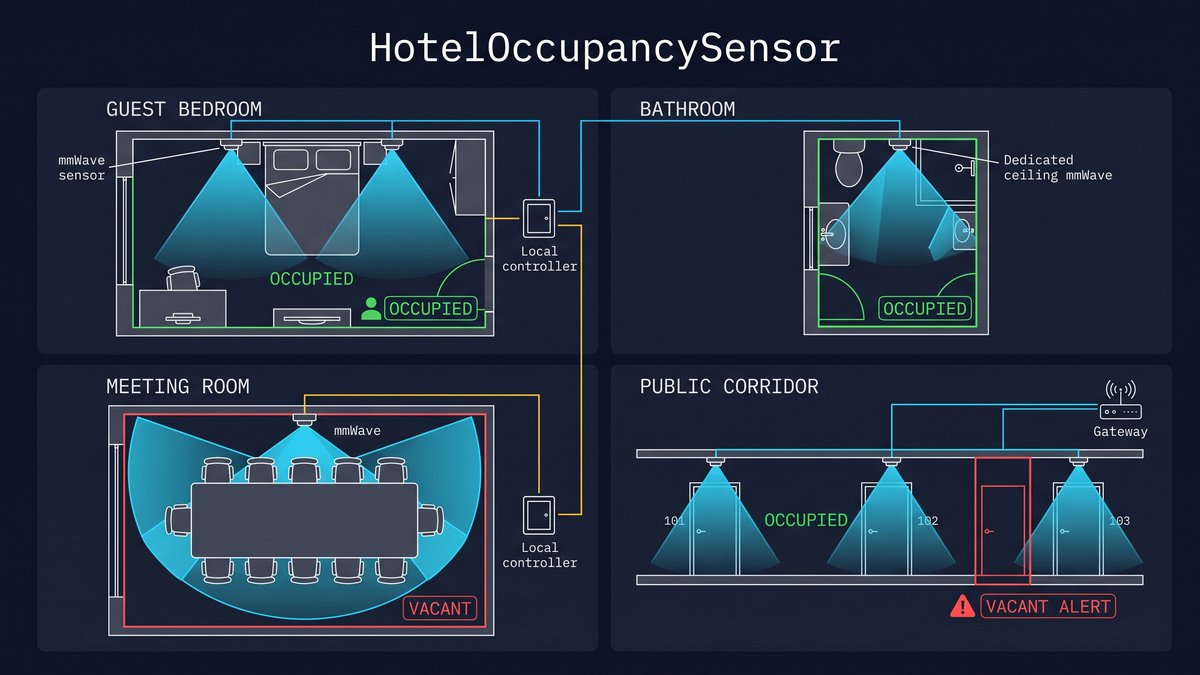
A hotel room occupancy sensing solution is a system that tells a guest room whether a person is physically present and feeds that signal into the room's energy control, so the HVAC and lighting operate only while the room is occupied. Unlike a motion detector that needs movement to trigger, a hotel room occupancy sensing solution built on mmWave radar detects a still guest by sensing breathing micro-motion, which is how a person who is asleep or reading in a chair still counts as occupied. The sensing element is typically a ceiling-mounted mmWave sensor wired to the room's thermostat, relay panel, or energy-management gateway, and the control logic switches to a setback temperature or turns off the lighting once the sensor reports the room vacant. Operators adopt a hotel room occupancy sensing solution over a PIR-based one because a PIR device loses the guest the moment they sit still, which either overcools an empty room or, worse, drops a sleeping guest out of comfort. Installing such a solution across a property gives the front desk and maintenance a real-time view of occupied versus vacant rooms, which supports housekeeping dispatch and un-sold inventory decisions alongside the energy saving at the core of the system.
Why a hotel room occupancy sensing solution saves energy
A hotel room occupancy sensing solution saves energy because the biggest waste in a guest room is running the air-conditioning for hours while nobody is inside. In a typical hotel day a room is empty for a large share of the time — while guests are out, between checkout and the next check-in, or during a housekeeping cycle — and a thermostat left at the guest's comfort setpoint keeps cooling or heating that empty space. A hotel room occupancy sensing solution closes that gap by putting the room into an energy-saving setback as soon as the sensor confirms vacancy, and returning it to the guest setpoint the moment presence returns, so the room is comfortable before the guest opens the door. The saving compounds because the largest consumers in a room, the air-conditioning and the water heater, are exactly the loads this signal controls. Building-management studies on occupancy-based control repeatedly report large heating and cooling reductions in spaces where the schedule or the occupants allow setbacks; a guest room is the ideal case because its occupancy is genuinely tied to the presence of one or two people. Over a year, the reduction in run hours across hundreds of rooms turns each ceiling sensor into a recurring operational saving, and the same occupancy truth feeds housekeeping priority and room-status decisions, which brings the property extra value beyond the power bill.
How the sensing hardware fits into a room
The hardware in a hotel room occupancy sensing solution is compact in shape but essential in placement. The common layout is a single ceiling-mounted mmWave module centered over the bed and seating area, wired by low-voltage cable to the room's control device, which is either the thermostat, a bedside energy panel, or a central room gateway. The ceiling position gives a clear view of the whole floor, so the radar beam covers the bed, the desk, and the bathroom access without being blocked by furniture. A hotel room occupancy sensing solution can also be integrated inside the ceiling sensor and body presence can be fused with the door-lock state or the card switch, which lets the system infer whether a room is occupied, vacant, or pre-dressed for arrival. Power is typically 12V or 24V DC drawn from the lighting or control circuit, and the mmWave module draws only a small fraction of a watt in idle, so the sensing adds a negligible load. Installation is done at head height-free ceiling access, and because no drilling into the guest-facing wall is needed, the wiring is hidden above the ceiling line. The sensor reports a presence/absence digital signal, an occupancy state, and a micro-motion event, all of which the energy gateway can use to act on.
Choosing the right sensor for the room size
Choosing a sensor is the decision that makes or breaks a hotel room occupancy sensing solution, and the main variable is detection reach for a still person. A 24GHz mmWave sensor detects micro-motion such as breathing to roughly 2.5 metres, which is enough for a standard guest room, a bed and a seating area, from a normal ceiling height. A 60GHz wideband sensor pushes micro-motion detection to about five metres, which covers a king-size bed plus a seating area or a junior suite from one ceiling unit. When specifying a hotel room occupancy sensing solution, match the reach to the largest floor area a single device must cover: standard rooms take a 24GHz unit, while suites, lobby alcoves and open-plan areas take 60GHz. The second variable is the detection chamber and false-trigger tolerance. Curtains moving on a vent, a pet, or airflow can cause motion-type triggers, so the solution should apply a stillness classifier that requires a sustained presence signature rather than a single moving edge. The third is the integration output: choose a sensor whose digital occupancy signal matches the open protocol your thermostat or gateway speaks, so the retrofit joins the existing room control without a second panel.
Retrofitting existing rooms with the solution
Retrofitting a hotel room occupancy sensing solution into an occupied, already-wired room is straightforward because the sensor only needs presence data and power, both of which sit above the ceiling. The installer runs a low-voltage line from the ceiling sensor to the thermostat or relay panel, and the control logic already present in the room switches to setback when the sensor reports vacancy. In a guest floor that was built before connectivity, the ceiling already has space for the sensor and the control device is reachable, so no guest-facing wall is touched and the room keeps operating normally through the installation. A hotel room occupancy sensing solution that ties into the existing thermostat, rather than replacing it, is the cheaper retrofit path and preserves the front-desk's familiar control. For rooms with a door card switch or an existing motion detector, the retrofit can fuse the new presence truth with those signals to avoid overwriting what already works. One important step is mounting the sensor clear of the return-air grille and the bathroom exhaust, because air movement in front of a radar face can create a false trigger; a clean, offset mount keeps the reading stable.
Energy control modes the solution runs
A hotel room occupancy sensing solution drives the room through a few well-defined control modes rather than a single on-off. The occupied mode holds the guest setpoint and runs the fan and lighting normally. The vacancy-unoccupied mode shifts the thermostat to a setback, typically several degrees in the cooling or heating direction, and turns off the lighting after a short timer. The pre-arrival mode is driven by the front desk or the door-lock, warming or cooling the room back toward the guest setpoint ahead of check-in. A well-designed hotel room occupancy sensing solution moves between these modes on real presence rather than on a clock, which removes the guesswork of fixed schedules that were set for the building's last occupancy. The transition out of vacancy is triggered by micro-motion the instant the guest returns, so the room is comfortable by the time the door swings open. Each mode is configurable per floor or per room type, letting the operator tighten setback in large rooms and keep it gentle in small ones. The control output is a standard low-voltage contact or a digital signal, which mainstream thermostats and energy gateways accept, and the power draw of sensing is minimal enough that the saving is never cancelled by the sensor itself.
Total cost and ROI of the solution
The economics of a hotel room occupancy sensing solution come down to the sensor and installation cost against the energy not spent on vacant rooms. Per-room hardware cost is low in a bulk retrofit, and the ceiling mount plus one low-voltage run keeps installation short. The operations estimate is usually built per room on the share of the day the room sits empty at the guest setpoint; when a sensor moves that time to setback, the run hours of the air-conditioning drop in proportion, which is where the payback comes from. A hotel room occupancy sensing solution also improves the guest experience, because an accurate presence signal avoids over-shooting the room after an early arrival and keeps lighting from switching off on a still guest. For a property with a periodic room-turnover pattern, the monthly saving in electricity across all rooms quickly exceeds the one-time hardware and labour, and the maintenance need is low because the sensing module has no moving parts. Buyers compare the sensor against a PIR alternative on false-trigger rate, reach, and protocol fit before ordering, and a pilot floor is the recommended first step, so the property measures real savings on its own occupancy pattern before a full rollout.
Deploying the solution across a property
Deploying a hotel room occupancy sensing solution at property scale starts with a standards document that fixes the sensor to use, the mounting position, the setback profile, and the protocol, so every room behaves the same. The operator pilots one floor, measures the before-and-after run hours, and then rolls out to the rest of the property once the pattern is confirmed. A centralized dashboard or the energy gateway collects occupancy state from every room, which lets maintenance spot a sensor that reads permanently occupied or permanently vacant and re-commission it. The front desk uses the same truth for housekeeping dispatch, because a room that has reported vacancy for an hour can be cleaned without a knock, and un-sold inventory can be pre-conditioned only when it is genuinely required. Documentation for each room, the sensor serial number, and the integration wiring should be kept on file so future maintenance and a second phase of rollout copy the proven configuration. Because the sensing and control are standards-based, a later upgrade to a smarter thermostat or a central energy platform carries the existing digital occupancy over without rework.
Comparing the solution with a card switch and PIR
A hotel room occupancy sensing solution is often discussed alongside two older approaches, a wall card switch and a PIR motion detector, and the comparison explains where each fits. A card switch requires the guest to insert a room card for power, so occupancy is inferred from the card rather than from the person; when a guest leaves a card in the reader or wedges it, the room stays powered and the saving is lost. A PIR detector senses gross motion, so it knows a guest is present on entry but goes quiet the moment the guest is still, which can drop a sleeping or reading guest out of the setpoint. A hotel room occupancy sensing solution built on mmWave radar overcomes both, because it reads true physical presence through breathing micro-motion rather than relying on a card or on movement. That makes it the strongest of the three for the purpose of running the room's energy by what is actually happening inside. The expected choice depends on the project: a card switch is the least hardware and a PIR is a low-cost trigger, but where the priority is reliable comfort plus real saving, the mmWave solution is the one that delivers both at once.
Sensor variants and what to specify
Specifying a hotel room occupancy sensing solution means choosing among a small number of sensor variants, and each maps to a room type. The 24GHz ceiling sensor is the standard room unit: it detects micro-motion such as breathing to about 2.5 metres, runs on a small fraction of a watt, and suits a normal guest room where the bed and seating area sit within that radius of the ceiling point. The 60GHz wideband sensor extends micro-motion reach to about five metres and adds finer resolution, which makes it the right unit for a suite, a lobby alcove, or an open floor plan where one device must see more of the space. Some variants add a backhaul for a central gateway, which joins each room's state into one dashboard, and a few expose a relay contact for an older thermostat, which keeps the retrofit simple. When a buyer specifies a hotel room occupancy sensing solution they should fix the detection reach to the largest room, the mounting distance from air vents, the output protocol to the thermostat, and the certification for the destination market. Fixing these four in the specification is what makes a pilot floor reproducible across a whole property.
Equipment cost and what drives it
The equipment cost of a hotel room occupancy sensing solution is set by the sensor, the power supply, and the integration, in that order of significance. The sensor price is the bulk of the hardware and it rises with reach: a 24GHz unit is the low-cost workhorse, while a 60GHz unit that covers suites carries a higher figure. A bulk retrofit across many rooms typically buys the sensors in volume, which brings the per-room hardware cost down, and the power can often be tapped from the existing lighting or control circuit so no separate supply is needed. The integration cost is the thermostat or gateway line that accepts the occupancy input; most rooms already have a thermostat, so a sensor that speaks a standard occupancy signal avoids buying a new panel. Shipping, duty and certification for the destination market add a smaller overhead. A well-scoped hotel room occupancy sensing solution therefore lands at a predictable per-room hardware figure that is dwarfed by the recurring energy saving once the rooms operate at setback for the empty hours. Buyers request a per-room line item, then compare the payback across their vacancy pattern to confirm the investment.
Installation and commissioning steps
Installing a hotel room occupancy sensing solution follows a short, repeatable sequence so the first floor sets the pattern for the rest. The installer first surveys the room to pick the ceiling mount point that sees the bed and seating area and stays clear of the return-air grille and the bathroom exhaust. The sensor is then fixed to the ceiling and powered from the lighting or control circuit, and a low-voltage run carries the occupancy signal down to the thermostat or gateway. Commissioning configures the device's detection reach to the room geometry, sets the vacancy timeout, and runs a walk test: enter, remain still, and leave to confirm the state flips to vacant after the set delay. The same four steps are replicated on every room, and the installer records the settings per room so a later issue can be traced. Because the sensor needs only presence data and power, and both sit above the ceiling, the work happens without touching the guest-facing wall and without taking the room out of service for long. A clean install and a documented commissioning run are what turn a hotel room occupancy sensing solution from a hardware kit into a reliable, maintainable operation.
Maintenance and avoiding sensor faults
Maintaining a hotel room occupancy sensing solution is light, because the sensing module has no moving parts, but a few checks keep the reading dependable. The sensor lens should be wiped occasionally to remove dust, and the mounting should be kept clear of a slowly moving curtain or a vent that could create a false occupancy trigger. A sensor that reads a room permanently occupied holds the space at the setpoint and silently loses the saving, so the dashboard should flag any room that has never reported vacancy and prompt a recommission. A sensor that reads vacant too often can be tuned by shortening or lengthening the vacancy timeout to match the room's use. Firmware updates, where offered, should be applied to the gateway so behaviour stays consistent across floors. Spare sensors are cheap and easy to swap, so keeping a small stock avoids a long outage. With these few habits a hotel room occupancy sensing solution runs for years at a consistent level of saving, and the documentation kept at rollout gives maintenance a fast path to the configuration of any single room that needs attention.
Guest experience and privacy of the solution
The guest experience of a hotel room occupancy sensing solution is deliberately invisible, and privacy is built into the design. The ceiling mmWave sensor reads whether a person is present by radar micro-motion; it does not form an image, record audio, or identify the guest, and the only output is a room-level occupied or vacant state used by the temperature control. Guests notice the outcome rather than the sensor: the room holds its setpoint through the night while they sleep, recovers to comfort on return, and lights stay off in an empty room. The sensor is an energy and comfort device, not a monitoring device, and a hotel answers a privacy question honestly by explaining that it reports occupancy to run the heating and cooling and nothing more. Staff use the same occupancy truth to plan housekeeping in a vacant room without a knock, which improves the guest's peace. In short, a hotel room occupancy sensing solution improves the stay by keeping the room ready and the energy bill low, while leaving the guest's private time private.
Where the market is headed
The direction of travel for a hotel room occupancy sensing solution is toward tighter building-system integration rather than a bigger sensor. Future rooms will fuse the ceiling presence reading with the door-lock, the front-desk reservation, and the housekeeping plan, so the room is pre-conditioned for a confirmed arrival and set back the moment it is released. The same presence truth is likely to join smart-room lighting scenes, in-room climate profiles per guest, and a central energy platform that compares buildings by run-hour efficiency. A modern solution is therefore built to last by exposing a standard occupancy output rather than a proprietary signal, because a standard output carries over when the thermostat or the platform is upgraded. The sensing hardware itself becomes cheaper and lower-power, making the retrofit economical in more room sizes. For a property that deploys a standards-based hotel room occupancy sensing solution now, the investment compounds: the rooms save every day, the data supports better operations, and the same wiring and protocol join the next generation of room control without rework.
Not sure which sensor fits your project?
Talk to our mmWave application engineers for a free consultation.
Find the right presence sensor for your hotel project
Compare the 3 protocols, check hotel-specific case studies, and download the installation guide
Related solutions
3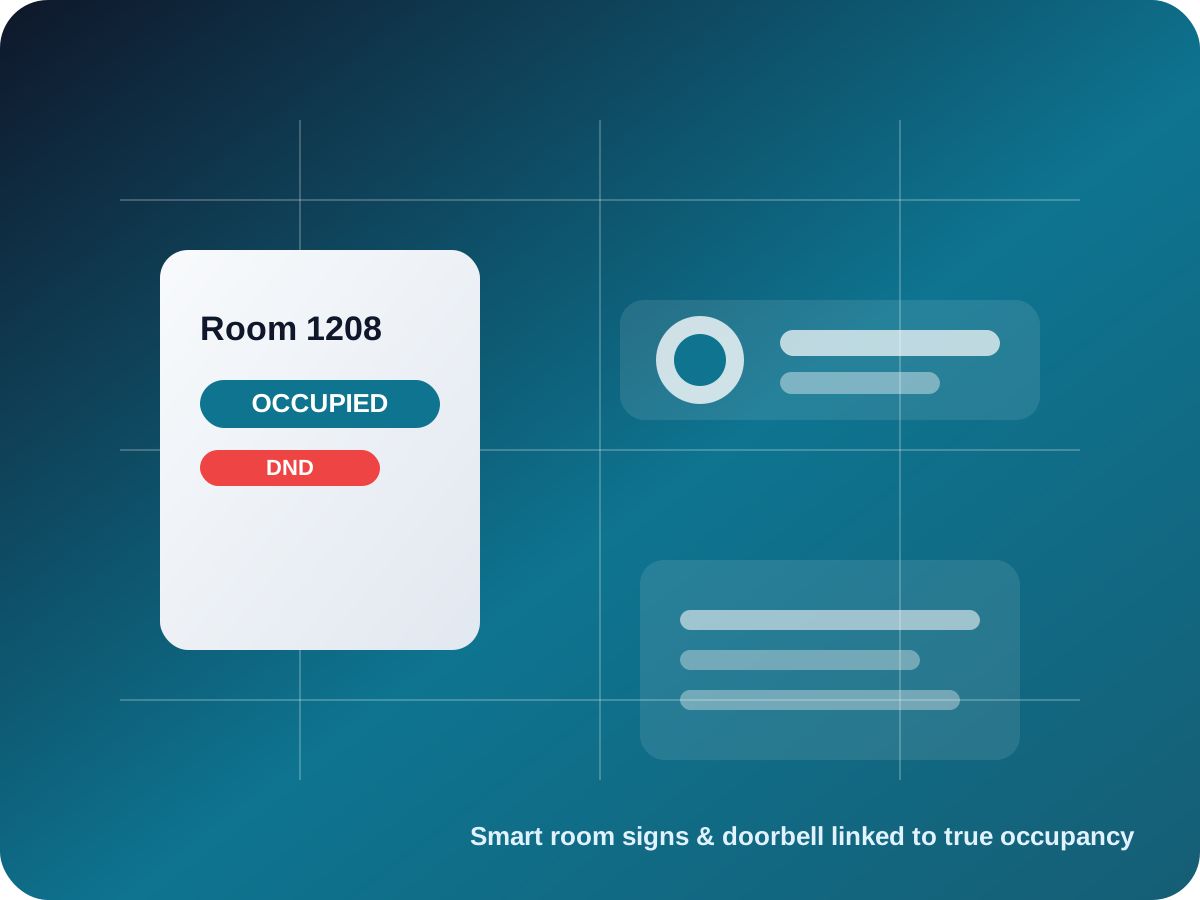
Hotel Energy Management — Occupancy Sensor HVAC & Lighting Control
Hotel energy management that uses an occupancy sensor to drive HVAC and lighting setback the moment a guest leaves. Our energy management system for hotels cuts room energy cost 20-40% with true occupancy detection.
It supports the same product context: hotel-room-occupancy-sensor.
Hotel Housekeeping Electronic DND System — Room Status Indicator
A hotel housekeeping electronic DND system links mmWave occupancy and a door sensor to show live room status. Our hotel do not disturb system replaces physical tags with true occupancy-driven room status signs.
It supports the same product context: hotel-room-occupancy-sensor.
Hotel Room Occupancy System — Intelligent Room Occupancy Management
A hotel room occupancy system that turns mmWave radar presence into live room status, housekeeping signals, and HVAC energy saving. Our intelligent room occupancy system manages guest rooms from one mmWave sensor mesh.
It supports the same product context: hotel-room-occupancy-sensor.
Related blog posts
3
Guest Room Occupancy Energy Management System
A guest room occupancy energy management system links ceiling mmWave presence to the thermostat and lighting so the HVAC runs only in truly occupied rooms.
It supports the same product context: ceiling-mmwave-occupancy-sensor.
How Do Hotel Thermostats Detect Occupancy in a Room?
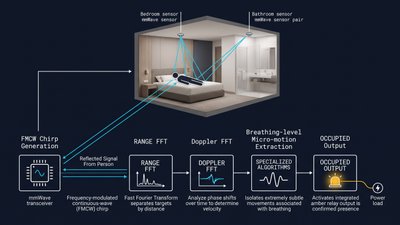
How do hotel thermostats detect occupancy: a ceiling mmWave sensor or a PIR reads presence and drives the AC, while a door switch or card adds a hint.
It supports the same product context: ceiling-mmwave-occupancy-sensor.
How Hotel Occupancy Sensors Work in a Guest Room
How hotel occupancy sensors work: a ceiling mmWave reads a still guest by breathing micro-motion and tells the thermostat whether to cool the guest room.
It supports the same product context: ceiling-mmwave-occupancy-sensor, hotel-room-occupancy-sensor.
Specify your hotel project with our engineers
Send your room count, ceiling type, and protocol preference. We will return a sample plan and quote within 24 business hours.
- Move from general guidance into a product or application discussion.
- Use RFQ when pricing, drawings, MOQ, or launch timing needs structure.
- Keep a direct contact path visible for fast clarifications and handoff.