Hotel Energy Savings vs Consumption Analysis
Compare hotel energy consumption patterns with achievable savings through occupancy-based automation and smart HVAC control systems for hotels.
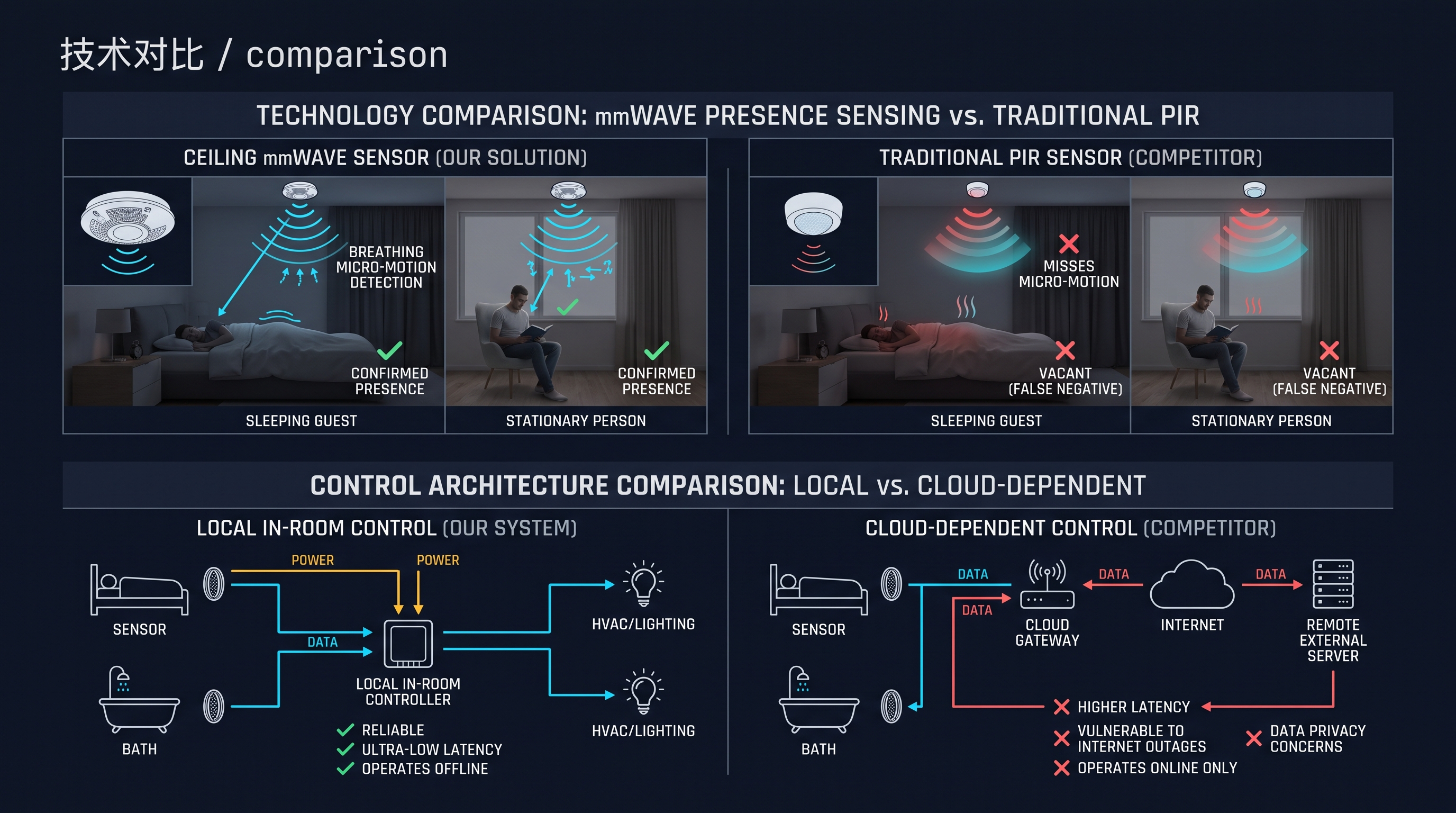
Hotel energy savings vs consumption represents the critical balance between operational necessity and cost efficiency in hospitality management. Energy consumption in hotels typically accounts for 6-10% of total operating costs, with HVAC systems comprising 40-60% of that consumption. Traditional hotel energy patterns show continuous operation regardless of actual occupancy, resulting in 20-30% wasted energy in unoccupied rooms. Modern occupancy-based automation systems can reduce this waste by 20-40% through real-time room status detection and automated HVAC/lighting control. The difference between consumption and savings lies in intelligent automation: consumption is the baseline energy required to operate facilities, while savings represent the reducible portion through smart occupancy detection and responsive control systems. Hotel energy management systems (HEMS) that integrate mmWave occupancy sensors achieve ROI within 12-18 months through reduced utility bills and extended equipment lifespan.
Understanding Hotel Energy Consumption Patterns
Hotel energy consumption follows predictable patterns that vary by property type, climate zone, and operational model. Full-service hotels typically consume 250-350 kWh per square meter annually, while limited-service properties range from 150-250 kWh per square meter. The largest energy consumers are HVAC systems (40-60%), lighting (15-25%), and water heating (10-15%). Traditional hotel energy management relies on fixed schedules and manual thermostat adjustments, which rarely align with actual room occupancy patterns. Studies show that guest rooms are unoccupied for an average of 12-16 hours per day, yet HVAC systems often operate at setpoint temperatures during these empty periods. This misalignment creates unnecessary consumption that directly impacts profitability.
HVAC consumption patterns reveal three distinct operational modes: occupied mode, unoccupied mode, and standby mode. In occupied mode, systems maintain guest comfort setpoints (typically 20-24°C). Unoccupied mode should shift to setback temperatures (26-28°C in cooling, 18-20°C in heating) to reduce energy draw while preventing moisture damage. Standby mode maintains minimal airflow for air quality. Traditional systems lack the occupancy detection capability to automatically transition between these modes, forcing energy managers to choose between guest comfort and energy efficiency. Smart occupancy sensors enable automatic mode switching based on real-time room status, ensuring energy is only expended when actually needed.
Lighting consumption represents another significant opportunity for savings. Guest room lighting accounts for 15-25% of room-level energy use, with vanity lights, entry lights, and bedside lamps being the primary consumers. Traditional hotel energy management relies on keycard switches that turn off all power when guests leave, but this approach is inflexible and can negatively impact guest experience. Modern systems use occupancy detection to selectively control lighting based on actual presence patterns, maintaining ambient safety lighting while eliminating wasteful full-power operation in truly unoccupied spaces. The difference between consumption and savings in lighting systems is particularly pronounced because LED fixtures combined with occupancy sensing can reduce lighting energy use by 60-80% compared to traditional always-on incandescent systems.
The Economics of Hotel Energy Savings
Hotel energy savings translate directly to improved profitability and competitive advantage. The hospitality industry operates on thin margins, typically 5-10% net profit, making energy cost reduction a high-impact lever. A 20% reduction in energy consumption can improve net profit by 2-4 percentage points, representing a significant competitive advantage. Energy savings also contribute to sustainability goals and increasingly important ESG (Environmental, Social, Governance) reporting requirements. Hotel chains with aggressive energy reduction targets can achieve carbon neutrality certifications and qualify for green building incentives, further enhancing market positioning.
The ROI calculation for energy-saving investments follows a straightforward formula: annual savings divided by implementation cost. Occupancy-based automation systems typically cost $150-300 per room including sensors, controllers, and installation. With average energy savings of $300-500 per room annually, the payback period ranges from 6-24 months depending on local energy rates and occupancy patterns. High-utility-cost regions such as California, New York, and European cities see faster payback (6-12 months), while regions with subsidized energy may require 18-24 months. Beyond direct utility savings, consider secondary benefits: extended HVAC equipment lifespan (20-30% longer life), reduced maintenance costs (15-25% fewer service calls), and improved guest satisfaction scores (consistent comfort without manual adjustments).
Energy savings also qualify for various utility rebates and tax incentives. Many utility companies offer commercial rebates for occupancy-based HVAC control systems, typically $50-150 per installed room. Federal tax credits such as Section 179D in the United States provide deductions for energy-efficient building systems. Some municipalities offer expedited permitting or density bonuses for green building certifications. When calculating hotel energy savings vs consumption ROI, incorporate these incentives to improve the business case. The combined effect of direct utility savings, rebates, tax benefits, and secondary operational improvements often yields total ROI exceeding 50% over a 5-year period.
Occupancy-Based Automation: The Technical Foundation
Occupancy-based automation systems form the technical bridge between energy consumption and achievable savings. These systems rely on three core components: occupancy sensors, control logic, and actuation devices. mmWave occupancy sensors have emerged as the preferred technology for hotel applications due to their ability to detect stationary humans including sleeping guests. Unlike PIR sensors that only detect gross movement, mmWave sensors detect micro-motion such as breathing and heartbeat, enabling true room-occupied status detection. This capability is critical for hotel applications where guests may be present but motionless (sleeping, reading, watching television). Detection accuracy above 99% for stationary humans ensures reliable automation without false negatives that would compromise guest comfort.
The control logic layer translates sensor data into HVAC and lighting commands. Advanced systems use multi-sensor fusion, combining occupancy detection with door status, temperature, and humidity inputs to make intelligent control decisions. Machine learning algorithms can learn individual guest preferences and building thermal characteristics to optimize setpoints for each room. The most sophisticated systems implement predictive control, anticipating occupancy patterns based on reservation data and historical behavior to pre-condition rooms just before guest arrival. This predictive approach maximizes guest comfort while minimizing energy waste from unnecessary early conditioning.
Actuation devices execute the control commands through building automation systems. Modern hotel energy management integrates with existing BACnet, Modbus, or proprietary HVAC systems through gateway devices. The gateway translates occupancy sensor signals into the protocol language understood by the building automation system, enabling seamless retrofit without replacing existing infrastructure. Lighting control typically uses DALI, 0-10V, or relay-based dimming depending on the fixture type. Wireless protocols such as Zigbee, WiFi, and Matter have gained popularity for retrofit applications due to minimal installation disruption. The choice of protocol depends on existing infrastructure, building size, and reliability requirements. Zigbee mesh networks offer robust reliability for large properties, while WiFi enables easier integration with property management systems.
Quantifying Hotel Energy Savings: By System Component
Breaking down hotel energy savings by system component provides actionable insights for prioritization investments. HVAC systems offer the largest savings potential at 20-40% reduction through occupancy-based control. The savings mechanism works through three primary levers: setback temperature during unoccupied periods, reduced runtime duration, and optimized fan speed. Setback temperature alone accounts for 15-25% of HVAC savings, as maintaining comfort setpoints in empty rooms represents pure waste. Reduced runtime duration contributes 5-10% savings by eliminating operation during truly unoccupied periods. Optimized fan speed through variable frequency drives (VFDs) adds 3-5% savings by matching airflow to actual cooling/heating demand rather than running at fixed speed.
Lighting systems deliver 30-50% savings through occupancy-based control combined with LED retrofits. The savings split between occupancy sensing (15-25%) and LED efficiency (15-25%) depends on existing technology. Hotels still using incandescent or fluorescent fixtures see the largest gains from LED conversion, while properties with existing LED benefit primarily from occupancy control. Bathroom lighting represents a particularly high-impact opportunity due to high usage combined with frequent unoccupied periods. Occupancy sensors in bathrooms can reduce lighting energy by 40-60% while maintaining guest convenience through motion-activated operation. Guest room lighting savings come from automatic dimming or shutoff during extended unoccupied periods while maintaining minimal ambient lighting for safety and housekeeping access.
Water heating systems offer 10-20% savings through occupancy-based recirculation pump control and temperature setback. Traditional hotel water heating systems maintain constant recirculation and temperature regardless of demand, resulting in significant standby losses. Occupancy-based control reduces recirculation pump runtime during low-demand periods and implements temperature setback during unoccupied hours. The savings are particularly pronounced in properties with centralized water heating systems serving multiple floors. Point-of-use water heaters combined with occupancy detection can achieve even higher savings by eliminating standby losses entirely, though the capital cost is higher. The ROI for water heating automation is typically longer than HVAC/lighting due to lower baseline consumption, but still attractive in high-utility-cost regions.
Implementation Strategies: From Pilot to Property-Wide Rollout
Successful implementation of hotel energy savings initiatives requires a phased approach starting with pilot testing and expanding based on measured results. Begin with a representative pilot of 10-20 rooms covering different room types, orientations, and usage patterns. This pilot should include comprehensive measurement and verification (M&V) to establish baseline consumption and quantify actual savings. Install sub-metering on HVAC circuits, lighting circuits, and individual room monitoring to capture granular data. The pilot period should span at least 3-6 months to capture seasonal variations and different occupancy patterns. Use the pilot data to refine control algorithms, identify edge cases, and train staff on new operational procedures.
Pilot results should inform the property-wide rollout strategy. Focus initial expansion on high-impact areas such as guest rooms with high energy consumption, rooms with long vacancy periods, and rooms with guest complaints about temperature inconsistency. Prioritize rooms with favorable HVAC infrastructure (e.g., recent VFD installations, zoned control) to maximize savings per dollar invested. Consider phased implementation by floor or building wing to minimize disruption to operations. Each phase should include training for housekeeping, engineering, and front desk staff on the new system operation and guest communication. Develop standard operating procedures for handling edge cases such as extended checkout times, maintenance access, and guest preferences override options.
Property-wide rollout requires integration with existing property management systems (PMS) and staff workflows. Occupancy data from sensors should feed into house scheduling systems to optimize room attendant routing. Engineering teams need dashboards showing system performance, energy savings, and maintenance alerts. Front desk staff should have visibility into room status for check-in/check-out coordination and guest communication. The system should include guest override options to maintain control over the guest experience while still capturing energy savings. Consider implementing guest-facing messaging explaining the sustainability benefits of the system to enhance guest satisfaction and participation in the program.
Comparative Analysis: Traditional vs Smart Energy Management
Traditional hotel energy management relies on fixed schedules, manual adjustments, and passive occupancy indicators such as keycard switches. These approaches have inherent limitations that cap achievable savings. Fixed schedules cannot adapt to variable guest behavior patterns, leading to either discomfort (conditioning turns off too early) or waste (conditioning continues after departure). Manual adjustments depend on staff vigilance and consistency, which varies across shifts and properties. Keycard switches provide binary occupied/unoccupied indication but cannot detect actual presence, leading to false negatives when guests remain in rooms without keycard reinsertion. These limitations typically cap traditional energy savings at 10-15% of total consumption.
Smart energy management based on real-time occupancy detection overcomes these limitations through continuous, accurate room status monitoring. mmWave occupancy sensors provide binary occupied/unoccupied status with 99%+ accuracy for stationary humans, eliminating false negatives that plague traditional systems. The continuous nature of the monitoring enables dynamic setback strategies that respond to actual usage patterns rather than arbitrary schedules. Smart systems also enable occupancy-based rate limiting, preventing simultaneous startup of all room HVAC systems after peak checkout times, which reduces peak demand charges and utility costs. The combination of accurate detection, continuous monitoring, and intelligent control enables 20-40% energy savings, 2-3x higher than traditional approaches.
The cost comparison between traditional and smart energy management reveals a compelling business case. Traditional approaches such as programmable thermostats cost $50-100 per room but deliver only 10-15% savings, yielding ROI of 6-12 months. Smart occupancy-based systems cost $150-300 per room but deliver 20-40% savings, yielding ROI of 6-18 months depending on utility rates. The higher upfront cost of smart systems is justified by the 2-3x higher savings and additional benefits such as improved guest comfort, reduced maintenance, and enhanced sustainability credentials. When evaluating hotel energy savings vs consumption, the total cost of ownership over 5-10 years strongly favors smart systems despite higher initial investment.
Overcoming Implementation Challenges
Implementing hotel energy savings initiatives faces several common challenges that can derail projects if not proactively addressed. Guest acceptance represents the most critical challenge. Guests may perceive automated systems as intrusive or as reducing their control over the room environment. Mitigation strategies include clear guest communication about the sustainability benefits, reliable override options that restore full guest control, and conservative initial setpoints that prioritize comfort over maximum savings. Train front desk staff to explain the system and handle guest questions or concerns. Consider guest satisfaction surveys to monitor acceptance and refine the guest experience. The system should be invisible in its operation—guests should not notice when automation is active except through improved comfort consistency.
Technical integration challenges can cause project delays and cost overruns. Legacy HVAC systems may lack the control interfaces needed for occupancy-based automation, requiring retrofit or replacement. Building automation systems from different manufacturers may use incompatible protocols, necessitating gateway devices or protocol translation. Wireless sensor networks may face interference from existing WiFi networks or building construction materials. Address these challenges through thorough pre-installation assessment, pilot testing of all components, and contingency planning for compatibility issues. Work with experienced integrators who understand both hospitality operations and building automation technology. The technical complexity justifies expert implementation rather than DIY approaches to ensure reliable long-term operation.
Staff adoption and operational change management represent another implementation hurdle. Engineering teams may resist new systems that require different maintenance procedures or troubleshooting approaches. Housekeeping teams may need to adjust workflows to accommodate room status-based scheduling. Front desk teams need training on guest communication and override procedures. Address these challenges through comprehensive training programs, clear documentation, and involving staff in the planning and pilot phases. Identify champions within each department who can advocate for the system and support their colleagues. Consider performance incentives tied to energy savings metrics to align staff motivations with project goals. Successful implementation requires treating the human elements as carefully as the technical elements.
Measuring and Verifying Energy Savings
Accurate measurement and verification (M&V) of hotel energy savings is essential for validating ROI, identifying optimization opportunities, and maintaining management support. Implement sub-metering at the building, floor, and room level to capture granular consumption data. Install monitoring points on HVAC circuits, lighting circuits, and individual room electrical panels. Use smart meters with data logging capabilities to capture consumption at 15-minute or hourly intervals. The baseline period should span at least 12 months to capture seasonal variations in both consumption and occupancy patterns. Normalize the baseline data for weather variables using heating degree days (HDD) and cooling degree days (CDD) to isolate the impact of occupancy-based automation from weather-related consumption changes.
Calculate savings using the International Performance Measurement and Verification Protocol (IPMVP) Option C approach, which compares pre- and post-installation consumption with normalization for weather and occupancy. The formula is: Savings = (Baseline Consumption - Post-Installation Consumption) normalized for weather and occupancy. Establish measurement and verification boundaries clearly at the project outset—typically at the room level for pilot projects and building level for property-wide implementations. Document all assumptions, calculation methods, and data sources to ensure transparency and reproducibility. Third-party verification adds credibility to the results, particularly for projects seeking green building certifications or utility rebates.
Beyond quantitative savings measurement, track qualitative metrics that impact the guest experience and operational efficiency. Monitor guest satisfaction scores related to room comfort and temperature consistency. Track maintenance request frequency related to HVAC and lighting systems. Measure housekeeping efficiency improvements from room status-based routing. These qualitative benefits, while harder to quantify directly, contribute significantly to the overall ROI and business case. Report both quantitative and qualitative results to management in a comprehensive dashboard that shows energy savings, cost reduction, guest satisfaction, and operational improvements. Regular reporting maintains momentum for the program and identifies opportunities for further optimization.
Future Trends in Hotel Energy Management
The future of hotel energy management lies in increasingly sophisticated automation and integration with broader smart building ecosystems. Artificial intelligence and machine learning will enable predictive optimization that anticipates energy demand before it occurs. Predictive models will incorporate reservation data, weather forecasts, historical occupancy patterns, and real-time building conditions to optimize HVAC operation proactively rather than reactively. These systems will learn individual guest preferences and automatically personalize room environments while still capturing energy savings through optimized setpoints and scheduling. The convergence of energy management with guest experience optimization will create systems that enhance sustainability without compromising comfort.
Grid-interactive building systems represent another emerging trend. Hotels will increasingly participate in demand response programs, automatically reducing energy consumption during peak grid periods in exchange for utility payments. These systems will use occupancy-based control to ensure guest comfort is not compromised during demand response events. Energy storage systems, particularly thermal storage using ice tanks or phase change materials, will shift energy consumption to off-peak periods when electricity rates are lower. Behind-the-meter renewable energy generation, particularly solar photovoltaics, will be integrated with energy management systems to maximize self-consumption and minimize grid purchases. The hotel of the future will be an active participant in the energy ecosystem rather than a passive consumer.
Standardization and interoperability will accelerate adoption of advanced energy management systems. Protocols such as Matter and Thread will enable seamless integration between occupancy sensors, HVAC systems, lighting, and guest room controls regardless of manufacturer. This interoperability will reduce installation costs, improve reliability, and enable hotel-wide optimization rather than siloed system operation. Cloud-based building management platforms will provide centralized visibility and control across multi-property portfolios, enabling enterprise-wide energy optimization strategies. These platforms will incorporate benchmarking, anomaly detection, and automated diagnostics to identify optimization opportunities and maintenance issues before they impact guest comfort or energy performance.
Conclusion: Strategic Approach to Hotel Energy Savings
Hotel energy savings vs consumption represents a strategic opportunity rather than merely a technical challenge. The properties that achieve the greatest success approach energy management as a core business function integrated with guest experience, operational efficiency, and sustainability goals. The technical foundation of occupancy-based automation provides the mechanism for capturing savings, but the strategic approach determines the magnitude and sustainability of results. Begin with comprehensive measurement to understand current consumption patterns and identify the highest-impact opportunities. Pilot new approaches on a limited scale to validate assumptions and refine the solution before property-wide rollout. Invest in staff training and change management to ensure successful adoption and long-term operation.
The business case for hotel energy savings initiatives is compelling across property types and climate zones. Even properties in regions with moderate energy rates can achieve attractive ROI through the combination of utility savings, rebates, tax incentives, and secondary operational benefits. The competitive advantages extend beyond direct cost reduction to include enhanced guest satisfaction, improved sustainability credentials, and better alignment with corporate ESG objectives. As energy costs continue rising and sustainability expectations increase, properties that implement comprehensive energy management today will be positioned for long-term success.
The path forward begins with accurate measurement of current consumption, identification of the highest-impact opportunities, and implementation of occupancy-based automation systems. Focus initially on HVAC and lighting, which together account for 55-85% of room-level energy consumption. Expand to water heating and other systems as initial successes build organizational support and capability. Continuously measure and verify results to validate ROI and identify optimization opportunities. Treat energy management as an ongoing operational discipline rather than a one-time project. With this strategic approach, hotels can achieve 20-40% reduction in energy consumption while enhancing guest satisfaction and positioning their properties for sustainable long-term success.
Not sure which sensor fits your project?
Talk to our mmWave application engineers for a free consultation.
Find the right presence sensor for your hotel project
Compare the 3 protocols, check hotel-specific case studies, and download the installation guide
Related products
1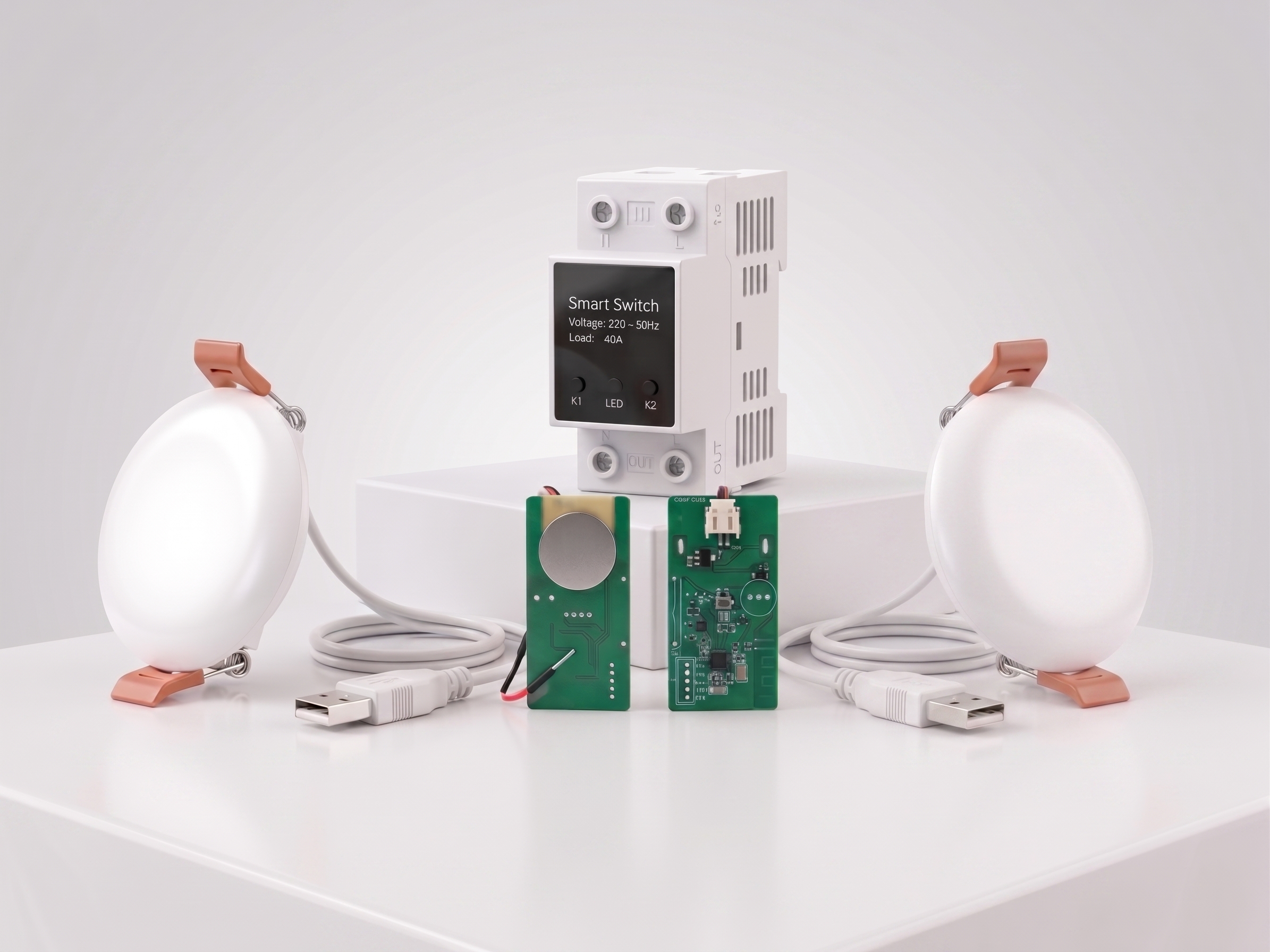
Hotel Energy Saving Control Kit — Dual mmWave Sensors, Door Sensor & Controller
A three-piece hotel energy saving control kit combines ceiling mmWave occupancy sensors for the bedroom and bathroom, an embedded door magnetic contact sensor, and a local central controller. Zero PMS and zero cloud: reduce HVAC and lighting waste with true occupancy detection.
This page already points to it as the next recommended reference.
Related solutions
3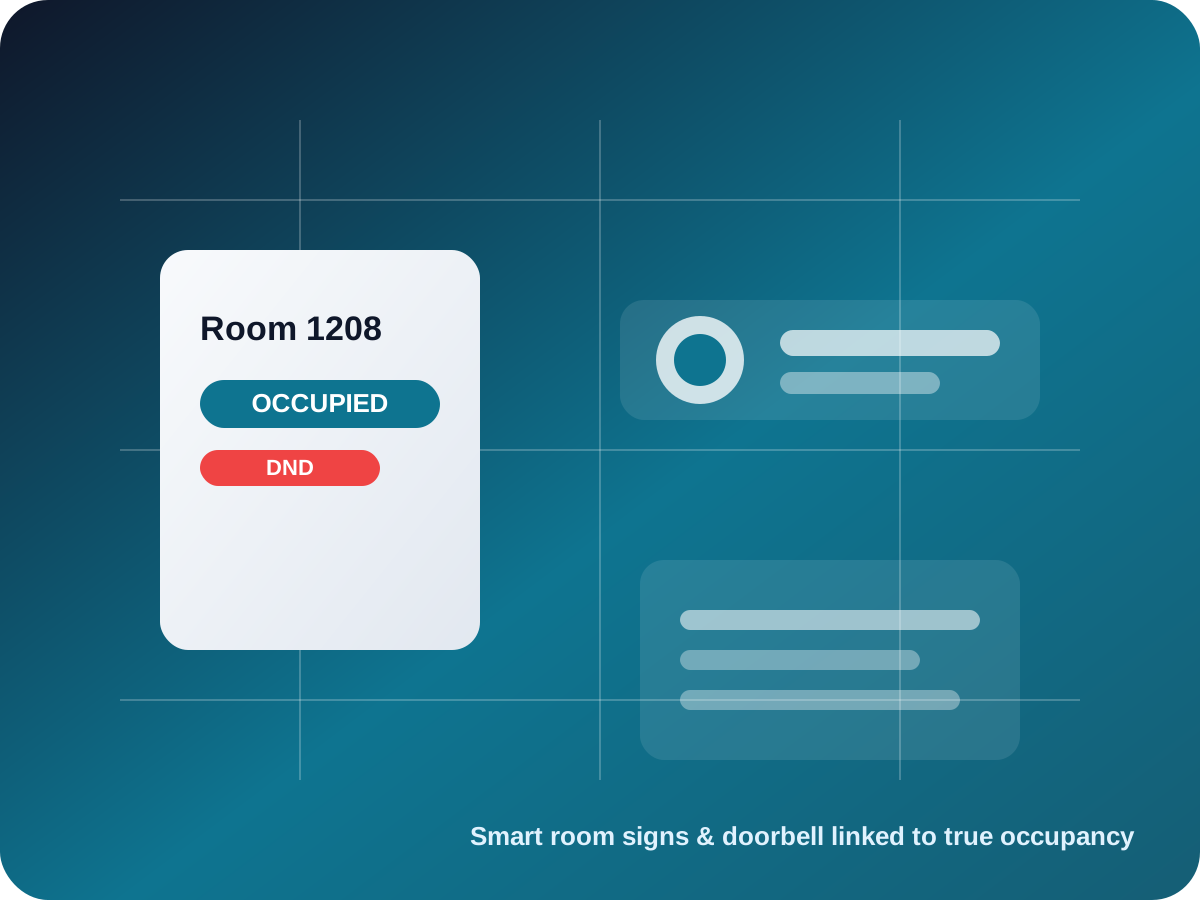
Hotel Energy Management — Occupancy Sensor HVAC & Lighting Control
Hotel energy management that uses an occupancy sensor to drive HVAC and lighting setback the moment a guest leaves. Our energy management system for hotels cuts room energy cost 20-40% with true occupancy detection.
It supports the same product context: Hotel Energy Saving Control Kit — Dual mmWave Sensors, Door Sensor & Controller, hotel-room-occupancy-sensor.
Hotel Housekeeping Electronic DND System — Room Status Indicator
A hotel housekeeping electronic DND system links mmWave occupancy and a door sensor to show live room status. Our hotel do not disturb system replaces physical tags with true occupancy-driven room status signs.
It supports the same product context: hotel-room-occupancy-sensor.
Hotel Room Occupancy System — Intelligent Room Occupancy Management
A hotel room occupancy system that turns mmWave radar presence into live room status, housekeeping signals, and HVAC energy saving. Our intelligent room occupancy system manages guest rooms from one mmWave sensor mesh.
It supports the same product context: hotel-room-occupancy-sensor, Hotel Energy Saving Control Kit — Dual mmWave Sensors, Door Sensor & Controller.
Related blog posts
3
Hotel Guest Experience Optimization Guide
Optimize hotel guest experience with occupancy sensors through automated comfort control, seamless service delivery, and personalized room environments.
It supports the same product context: hotel-room-occupancy-sensor, ceiling-mmwave-occupancy-sensor, Hotel Energy Saving Control Kit — Dual mmWave Sensors, Door Sensor & Controller.
Hotel Occupancy Sensor ROI Calculator Guide
Calculate hotel occupancy sensor ROI including energy savings, implementation costs, payback periods, and total cost of ownership analysis for hotels.
It supports the same product context: Hotel Energy Saving Control Kit — Dual mmWave Sensors, Door Sensor & Controller, ceiling-mmwave-occupancy-sensor, hotel-room-occupancy-sensor.
Inncom vs Honeywell Thermostat Comparison
Compare Inncom and Honeywell hotel thermostat systems across functionality, integration capabilities, cost structure, and suitability for hotel properties.
It supports the same product context: Hotel Energy Saving Control Kit — Dual mmWave Sensors, Door Sensor & Controller, ceiling-mmwave-occupancy-sensor.
Specify your hotel project with our engineers
Send your room count, ceiling type, and protocol preference. We will return a sample plan and quote within 24 business hours.
- Move from general guidance into a product or application discussion.
- Use RFQ when pricing, drawings, MOQ, or launch timing needs structure.
- Keep a direct contact path visible for fast clarifications and handoff.