Hotel Occupancy Sensor: mmWave Radar True Room Status Guide
A hotel occupancy sensor with mmWave radar detects a sleeping guest, not just walking. This guide covers true room status, housekeeping, and HVAC energy savings.
What a hotel occupancy sensor actually detects
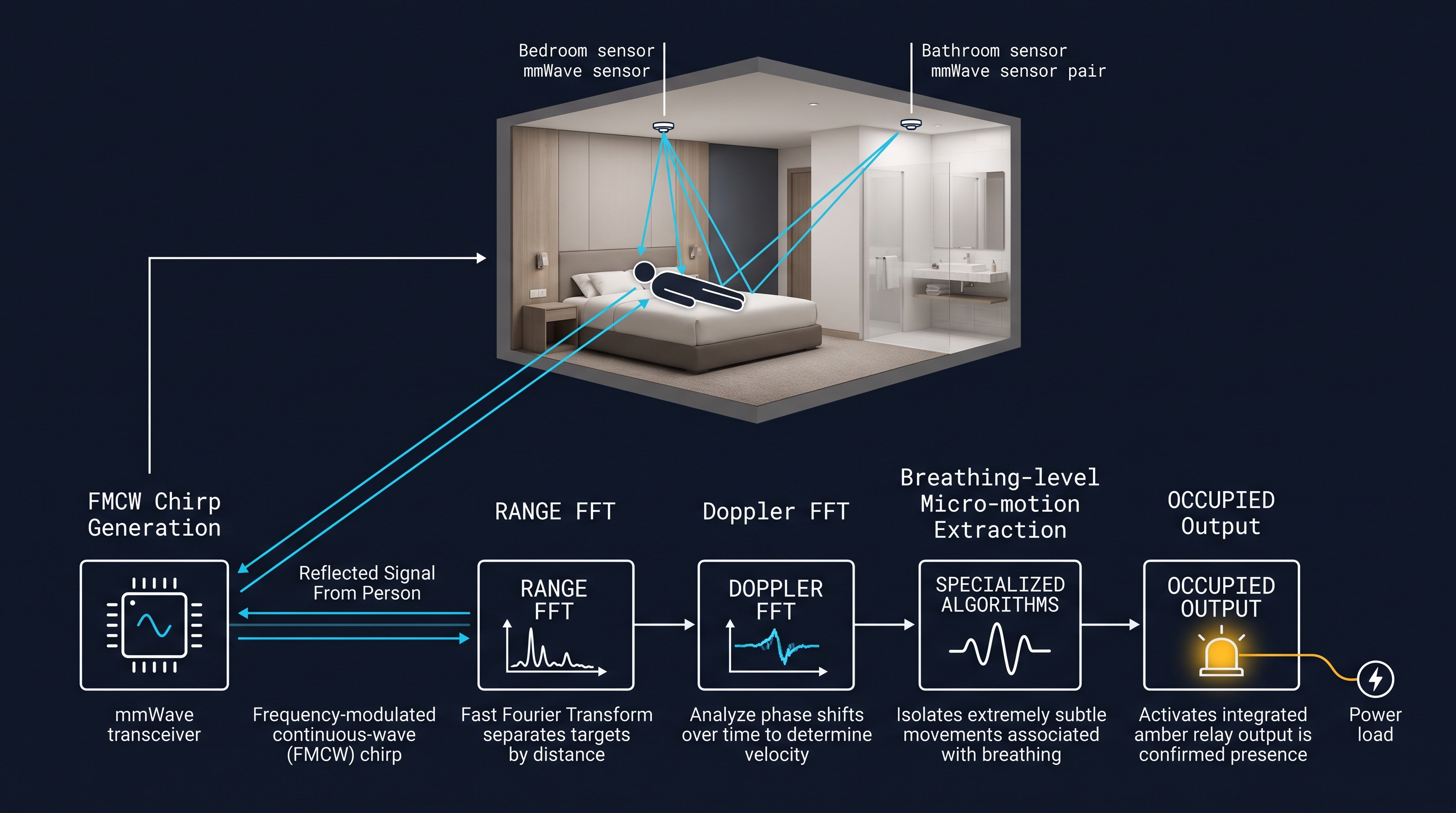
A hotel occupancy sensor is a device mounted on the ceiling or wall of a guest room that determines whether someone is present, so it can drive lighting, air conditioning, and housekeeping signals. The core task of a hotel occupancy sensor is not to count footsteps, but to report true room status, including the moments when a guest is asleep, seated, or reading with almost no movement. A hotel occupancy sensor that only reacts to gross motion fails exactly when it matters most: a guest in bed produces almost no infrared change, so a PIR-based solution falsely reports a vacant room after a few minutes and cuts the lights. The right hotel occupancy sensor uses mmWave radar to detect micro-motion such as breathing, holding the room occupied until the guest truly leaves. For hotel operators, the difference between a hotel occupancy sensor that detects breathing and one that only detects walking is the difference between guest comfort and a stream of complaints.
Why PIR hotel occupancy sensors fail on sleeping guests
A PIR hotel occupancy sensor relies on the contrast between body heat and a cooler background to trigger, so it has two well-documented failure modes. First, a still guest, whether sleeping, reading, or working at a desk, produces little thermal change, so the PIR hotel occupancy sensor falsely reports a vacant room and turns off the air conditioning. Second, when ambient temperature approaches skin temperature in summer, the thermal contrast disappears and PIR false-positive rates spike. An mmWave hotel occupancy sensor avoids both problems: radar can detect micro-motion and breathing at 2.5 meters, still judging the room occupied while a guest sleeps, and it is unaffected by ambient temperature. Most mmWave radar occupancy sensors on the market only detect micro-motion within 1.5 meters, too short to cover a queen-size bed from a standard ceiling height, while a hotel occupancy sensor built on 24GHz wideband radar reaches 2.5 meters and 60GHz versions reach 5 meters. For hotels in tropical and desert climates, an mmWave hotel occupancy sensor is the only solution that works consistently across seasons.
Hotel occupancy sensor comparison table
| Parameter | mmWave hotel occupancy sensor | PIR hotel occupancy sensor |
|---|---|---|
| Detects sleeping guest | Yes (breathing at 2.5–5m) | No |
| Affected by room temperature | No | Yes (fails when warm) |
| Max motion detection | 10–12m | 6–8m |
| Micro-motion range | 2.5–5m | ≤1.5m |
| False-vacant errors | Minimal | Frequent when still |
The 10–12 meter motion range of mmWave occupancy detection covers a full guest room from a single ceiling unit, and the 2.5–5 meter micro-motion range ensures a sleeping or seated guest is never missed. The 120° field of view provides full coverage when ceiling-mounted. PIR occupancy sensors typically lose accuracy against reflective surfaces and in warm rooms, while a wideband mmWave hotel occupancy sensor resists interference from other 5.8GHz devices common in dense hotel deployments. For specifiers, the comparison between occupancy sensors is not close: mmWave wins on every occupancy-accuracy dimension.
How a hotel occupancy sensor drives housekeeping and HVAC
A hotel occupancy sensor feeds real-time room status to two systems that save hotels money. Housekeeping uses the signal to skip occupied rooms and prioritize vacated ones, no more knocking on occupied doors or waiting in corridors. HVAC uses the signal to set back temperature and lighting the moment a guest leaves, not after a fixed 15-minute timer. Hotels typically cut room energy cost 20–40% with true occupancy-based control, because the hotel occupancy sensor responds to actual departure within seconds rather than guessing with a timer. A hotel occupancy sensor that detects breathing ensures the room stays occupied until the guest leaves, so the air conditioning never shuts off on a sleeping guest, the most common top complaint with PIR solutions. A ceiling hotel occupancy sensor combined with a recessed door contact gives the building both instant entry detection and sustained occupancy detection.
Installing a hotel occupancy sensor
A hotel occupancy sensor flush-mounts into a standard ceiling cutout. DC5V low-voltage input simplifies OEM integration, the hotel occupancy sensor can embed into powered fixtures or pair with a supplied adapter for retrofit. As a Zigbee device, the hotel occupancy sensor uses 3.0 mesh networking that scales to whole-floor deployment without WiFi congestion, and it works with Tuya Smart Life and any standard Zigbee 3.0 gateway. A single ceiling hotel occupancy sensor covers up to 10 meters of motion and 2.5 meters of micro-motion with a 120° field; suites can use two units. The hotel occupancy sensor shares the same network as the door sensor and the room signage, so housekeeping sees one unified room-status signal.
Choosing the right hotel occupancy sensor
Choosing a hotel occupancy sensor comes down to three questions: does it detect a sleeping guest, does it scale to hundreds of rooms, and does it fit the existing network. An mmWave hotel occupancy sensor answers yes to all three, it senses breathing where PIR fails, uses Zigbee mesh for building-scale reliability, and drops into existing smart-building stacks without lock-in. Whether the project is a new hotel or a retrofit across mixed lock fleets, a hotel occupancy sensor built on 24GHz or 60GHz wideband radar is the reference choice for occupancy accuracy. The hotel occupancy sensor is the core of any guest-room automation deployment, and the mmWave version is built for scale.
Certifications and export
CE, FCC, and RoHS certified for direct import into EU and US markets, every hotel occupancy sensor ships with compliance documents. ISO 9001 manufacturing ensures each hotel occupancy sensor meets consistent quality. Samples ship in 7–10 days; mass production runs 20–30 days with FOB Shenzhen, CIF, or DDP logistics. OEM branding and protocol customization are available.
Not sure which sensor fits your project?
Talk to our mmWave application engineers for a free consultation.
Find the right presence sensor for your hotel project
Compare the 3 protocols, check hotel-specific case studies, and download the installation guide
Related solutions
3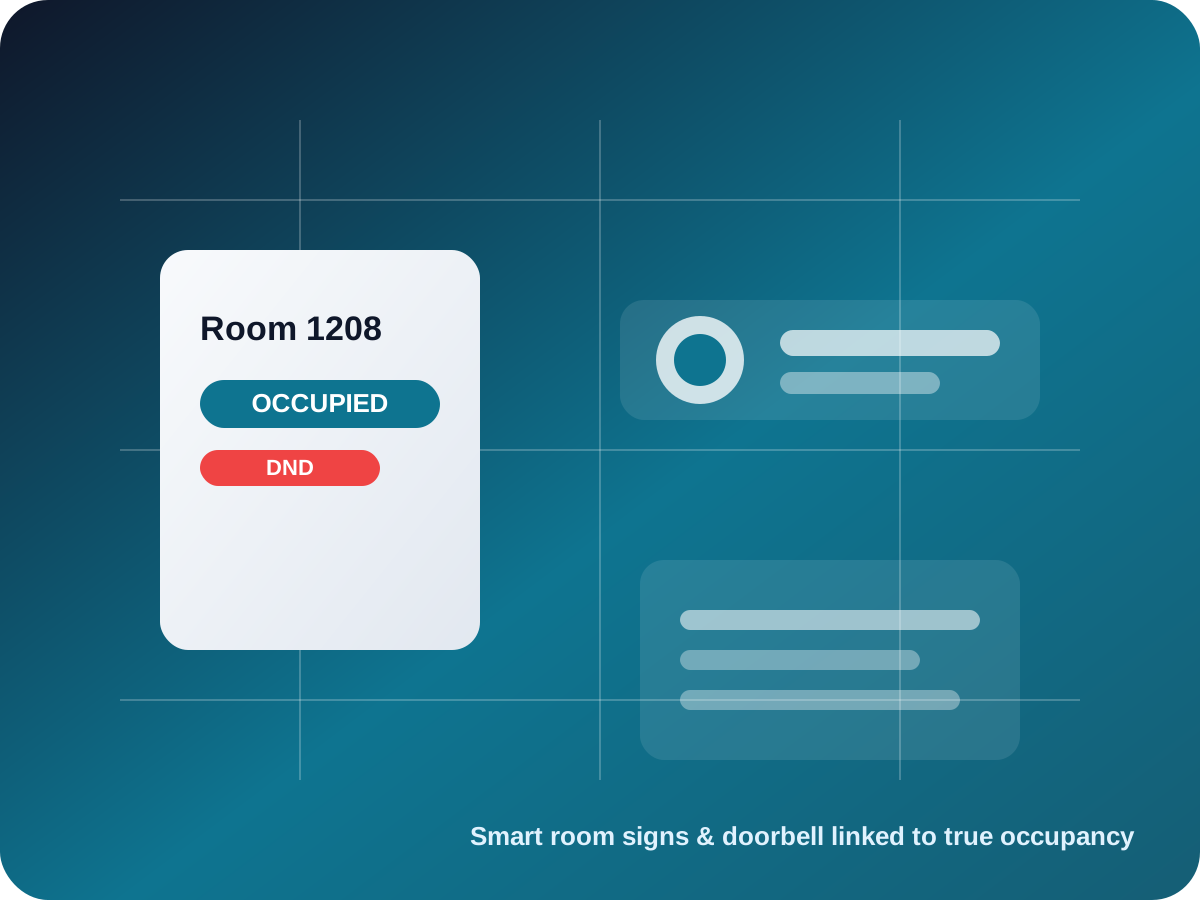
Hotel Energy Management — Occupancy Sensor HVAC & Lighting Control
Hotel energy management that uses an occupancy sensor to drive HVAC and lighting setback the moment a guest leaves. Our energy management system for hotels cuts room energy cost 20-40% with true occupancy detection.
It supports the same product context: hotel-room-occupancy-sensor.
Hotel Housekeeping Electronic DND System — Room Status Indicator
A hotel housekeeping electronic DND system links mmWave occupancy and a door sensor to show live room status. Our hotel do not disturb system replaces physical tags with true occupancy-driven room status signs.
It supports the same product context: hotel-room-occupancy-sensor.
Hotel Room Occupancy System — Intelligent Room Occupancy Management
A hotel room occupancy system that turns mmWave radar presence into live room status, housekeeping signals, and HVAC energy saving. Our intelligent room occupancy system manages guest rooms from one mmWave sensor mesh.
It supports the same product context: hotel-room-occupancy-sensor.
Related blog posts
3
Hotel Energy Savings vs Consumption Analysis
Compare hotel energy consumption patterns with achievable savings through occupancy-based automation and smart HVAC control systems for hotels.
It supports the same product context: hotel-room-occupancy-sensor.
Hotel Guest Experience Optimization Guide
Optimize hotel guest experience with occupancy sensors through automated comfort control, seamless service delivery, and personalized room environments.
It supports the same product context: hotel-room-occupancy-sensor.
Hotel Occupancy Sensor ROI Calculator Guide
Calculate hotel occupancy sensor ROI including energy savings, implementation costs, payback periods, and total cost of ownership analysis for hotels.
It supports the same product context: hotel-room-occupancy-sensor.
Specify your hotel project with our engineers
Send your room count, ceiling type, and protocol preference. We will return a sample plan and quote within 24 business hours.
- Move from general guidance into a product or application discussion.
- Use RFQ when pricing, drawings, MOQ, or launch timing needs structure.
- Keep a direct contact path visible for fast clarifications and handoff.