Hotel Occupancy Sensor Energy Savings: What to Expect in Guest Rooms
Hotel occupancy sensor energy savings scale with the hours a room sits vacant at the guest setpoint, moved to a setback by ceiling mmWave presence.
What drives hotel occupancy sensor energy savings
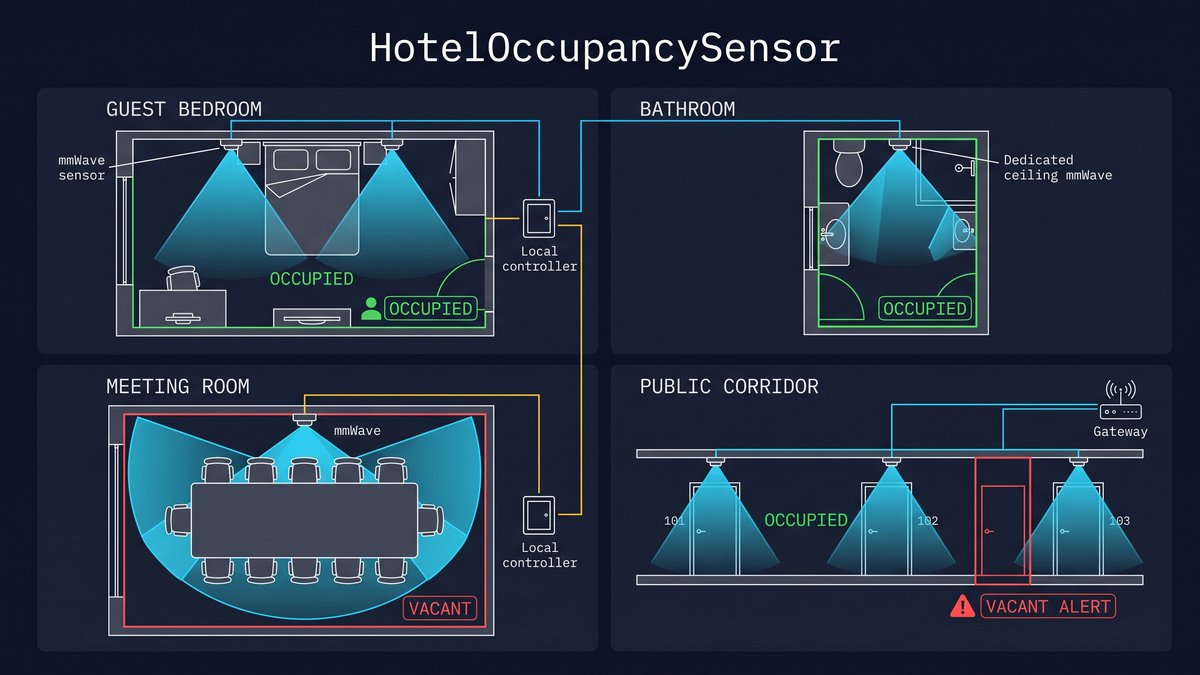
Hotel occupancy sensor energy savings come from one mechanism: a room stops being air-conditioned at the guest setpoint during the hours it is empty. A ceiling mmWave sensor reads the room as vacant and the thermostat steps to a setback temperature, so the air-conditioning and the lighting no longer run at full load while nobody is present. The size of hotel occupancy sensor energy savings therefore depends on how many hours in a day the room sits vacant at the comfort setpoint, and on how far the setback moves the load. A hotel room is empty for a meaningful part of each day — between checkout and the next check-in, while guests are out, and during housekeeping — and every one of those hours currently holds the room at comfort. Moving those hours to a lower-load setback reduces the run time of the compressor or the heating element in proportion to the empty time. Because the sensing reads a still guest, the saving is realized without compromising comfort: while the occupant is actually present, even asleep, the room stays at the guest setpoint. The honest way to estimate hotel occupancy sensor energy savings at a property is to measure its own vacancy pattern, not to assume a fixed percentage for every site.
Why the vacant hours are the saving
The reason vacant hours are the whole game in hotel occupancy sensor energy savings is that the largest guest-room load, air-conditioning, runs continuously at the setpoint whether anyone is there. When a guest leaves in the morning the thermostat continues to hold the cooling setpoint in the empty room, so the compressor cycles against an empty space for the entire day until the next arrival. A hotel occupancy sensor energy savings system converts that continuous comfort hold into a setback the moment the sensor reports vacancy. The load saved is proportional to the fraction of the day the room is empty and the setpoint distance of the setback: a room that is empty six hours a day and is stepped from 22°C to 28°C on a hot day stops running its compressor for those hours, which is the reduction that shows up on the power bill. Each room may appear to save a modest amount, but across a property of hundreds of rooms, the sum of vacant-hours is large and steady, which is why the retrofit pays out as a recurring operational saving rather than a one-off.
Setting the setback to realize the saving
The setback decision shapes hotel occupancy sensor energy savings more than any other setting. In a cooling season, a room held at the guest setpoint in the low 20s can be stepped several degrees toward a vacant setpoint in the high 20s; the larger and longer that differential, the larger the saving. The heating season mirrors it by stepping toward a cooler unoccupied setpoint. Operaturally, even a modest setback on a long vacancy produces a meaningful reduction in runtime, so the configuration can be gentle to keep the guest comfortable while still cutting the biggest part of the waste. A hotel occupancy sensor energy savings system also switches the lighting off after a short vacancy timer, which removes the kept-on bathroom and bedroom lights that add waste in every empty room. The setback depth is configurable per floor or room type, allowing the operator to tighten the profile on large rooms and keep it lighter on small ones, and the return to the guest setpoint is triggered by renewed presence so the room is ready before the guest opens the door.
Estimating the saving for one property
Estimating hotel occupancy sensor energy savings for a specific property is a small arithmetic exercise rather than a guess. Start from the average hours per day each room is vacant at the setpoint, multiply by the number of rooms, and apply the setpoint reduction to the HVAC runtime. The two figures that matter are the vacancy share and the setback depth, both of which a pilot floor measures directly. An operator installs the sensor on one floor, records the run hours of the air-conditioning before and after the retrofit over the same season, and uses the measured change to project the saving to the rest of the property. This pilot-first method is more reliable than quoting a generic percentage, because occupancy patterns differ by market, season and hotel type. It also gives the project team the number they need for the payback calculation: the one-time hardware and installation cost against the recurring reduction in kWh. Once the pilot confirms the behaviour in one room, the same configuration scales predictably to the other rooms, since each operates on the same sensing and control logic.
Comparing a sensor to other control options
In comparing ways to reduce guest-room energy, hotel occupancy sensor energy savings is the approach that matches control to reality. A card switch saves only when a guest inserts a card, which guests often skip or, with an in-room-card trick, defeat, so the saving is unpredictable. A PIR motion detector reacts to movement but drops a still guest, risking comfort or overcooling. A schedule based on check-in and check-out times is a guess that drifts from real occupancy. The ceiling mmWave sensor avoids all three by reading presence directly, whether the guest is asleep or active, and by handing that truth to the thermostat. Compared with the other options the sensor adds the ability to save in the long, quiet empty periods that schedules and PIR miss. The trade-off among sensors is reach and false-trigger, where a 24GHz unit fits a standard room and a 60GHz unit covers a suite, so the choice is matched to the space.
The role of accurate presence in the result
The accuracy of the presence reading determines how much of the theoretical hotel occupancy sensor energy savings is actually captured. A sensor that reads a vacant room as occupied keeps the HVAC at the setpoint and loses the saving for that period. A sensor that reads an occupied room as vacant steps to setback too early and risks the guest's comfort. The mmWave approach minimizes both errors because it detects micro-motion, so a still guest is not mistaken for vacancy, and it clears to vacancy only after a sustained absence, so a door swing or a curtain does not hold the room occupied. The vacancy timeout is the balancing parameter: too long wastes empty hours, too short risks dropping an occupant. Setting it to the operator's preference, usually a short delay followed by the setback, captures the saving while preserving comfort. With the same configuration across a floor, the repeatable presence reading is what turns a mechanical saving estimate into results that match the calculation.
Making the saving consistent across a property
Making hotel occupancy sensor energy savings consistent at property scale is about standards and measurement. A specification fixes the sensor model, mounting position, setback profile and vacancy timeout so every room saves the same way. The operator pilots one floor, measures run hours before and after, and rolls the proven profile to the rest of the property. A central dashboard collects occupancy and run-hour data per room, which flags a sensor that reads permanently occupied and is holding a room at setpoint, so it can be recommissioned rather than silently losing the saving. The same occupancy truth is used by housekeeping, because a room vacant for a set time can be serviced without a knock, and by the front desk for pre-conditioning. By documenting the sensor serial, wiring and settings per room, the property reproduces the saving in a later phase of rollout or through a maintenance cycle without re-engineering the configuration.
The role of the setback temperature
The setback temperature is the hand that reaches into the annual electricity bill of a hotel occupancy sensor energy savings scheme. When a room reports vacant, the thermostat steps from the guest setpoint to a setback that is several degrees away in the cooling or heating direction. A smaller setback, of a degree or two, saves a little and returns to comfort quickly; a larger setback, of four or more degrees, saves more but takes longer to recover when the guest returns. The right choice balances that recovery time against the length of the vacancy, so a room empty all day can take a deeper setback than a room that turns around in an hour. In a hotel occupancy sensor energy savings system the setback is configurable per floor or per room type, which lets an operator tighten it for high-turnover rooms and relax it for suites. Because the sensing and control are one chain, the setback is applied only when the room is genuinely empty, and the room comes back to the guest setpoint on renewed presence without the guest having to do anything.
Why occupancy patterns differ by hotel type
Hotel occupancy sensor energy savings varies by type of hotel because the occupancy rhythm of the room differs. A business hotel sees its rooms empty during the day while guests are at meetings and full at night, which gives a long, predictable vacant block that a sensor turns into saving. A resort sees guests in the room at midday for a rest and out in the evening, a pattern that a schedule would miss but a sensor follows exactly. A transit or airport hotel turns rooms over on short stays, so the vacancy windows are many but short, and a fast sensor with a tight timeout captures each one. The point is that no single percentage describes the saving, because the vacant time differs. The honest figure comes from measuring a property's own pattern with a pilot floor. In every case the mechanism of hotel occupancy sensor energy savings is the same, the vacant hours move to a lower-load setback, but the size of the result scales with how many hours a property actually leaves rooms empty at the setpoint.
How the lighting load adds to the saving
Hotel occupancy sensor energy savings is not limited to the air-conditioning, because the same occupancy signal also controls the lighting. A room left lit by a guest at check-out, or by a housekeeper between rooms, runs the lamps and the associated cooling load until someone turns it off. The ceiling sensor sends the vacant state to the lighting circuit, which switches the lamps off after a short timer, so an empty room is not left lit for hours. The lighting saving is smaller than the HVAC saving per room, but it is real and it is captured with no extra hardware, since it comes from the same occupancy reading. The lights also come back automatically on presence, so a returning guest does not fumble in the dark. Together the HVAC and the lighting reductions give a hotel occupancy sensor energy savings deployment a cleaner overall bill, and the lighting part has the additional benefit that a dark, unoccupied room signals housekeeping and reduces the perceived waste of a floor that looks empty while still lit.
Seasonal differences in the saving
The saving from a hotel occupancy sensor energy savings system moves with the season because the load it controls is weather-dependent. In a cooling season the air-conditioning runs hardest, and the vacant rooms it no longer cools at the setpoint represent the largest reduction, so the system earns the most in hot months. In a heating season the heating load is the main consumer, and the vacant rooms stepped to a lower setpoint save on the heating element or the heat pump. In mild shoulder months the HVAC load is lighter, so the raw energy saving is smaller even though the mechanism runs the same. This does not mean the system is weak, only that its benefit is seasonal. A property should expect the biggest numbers in the deep cooling or heating season and should measure the annual saving across a full year, because a summer-only measurement overstates the average and a spring-only measurement understates it. A hotel occupancy sensor energy savings deployment is best assessed on a twelve-month basis, when the seasonal variation averages out into a reliable figure.
Estimating the energy bill impact
The impact on the energy bill from hotel occupancy sensor energy savings can be estimated step by step before it is measured. Start from the property's total HVAC load and the share of each day rooms sit vacant. Multiply the vacant hours by the number of rooms to get the room-hours that could run at a lower load, then apply the setback effect on the HVAC runtime for those hours. The result is an estimated reduction in kWh that can be priced at the local tariff to see the monthly and yearly figure. This arithmetic is only an estimate, and the measured saving from a pilot floor should confirm it, because occupancy reality and the building's efficiency shape the outcome. The value of the estimate is that it gives a project budget before committing, and it shows the payback period based on the hardware and install cost. When a property compares hotel occupancy sensor energy savings figures from different suppliers, the same method lets it judge them on the same assumptions rather than on quoted percentages that may not apply to its own occupancy.
The comfort value that rides along
The true return from hotel occupancy sensor energy savings includes comfort, not just the power bill, because the sensor holds the setpoint while a guest is actually present. A PIR-driven room can drop a still guest into a setback, leaving them to wake cold, while the mmWave reading keeps a sleeping guest at the setpoint all night. This protects the guest satisfaction score while the energy control does its work on the empty hours. The presence truth also supports housekeeping, since a room vacant for a set time can be serviced without a knock, and the front desk can pre-condition a confirmed room and leave an unsold one at setback. So the saving is delivered alongside a more comfortable room and a smoother operation. A property should weigh hotel occupancy sensor energy savings as the power reduction plus the comfort and operational benefit, since all three come from the same reliable presence reading and all three improve the running of the hotel.
Common reasons the saving comes in low
When hotel occupancy sensor energy savings comes in below the estimate, the cause is usually a correctable operational detail. A sensor mounted over the return-air grille reads the airflow as occupancy and holds a vacant room at the setpoint, so the saving for that room is lost; moving the mount fixes it. A vacancy timeout set too long keeps an empty room at comfort for longer than needed, and shortening it recovers the saving. A room that is never at the guest setpoint in the first place, because the guest changed it or left the controls in a warmer position, saves less because there is less to move. A sensor that reports occupied all day, perhaps from a stuck reading, holds a room at comfort continuously, and the dashboard should flag it for recommissioning. Each of these is visible in the run-hour data, so a property that watches the dashboard can find and fix the leaks and bring the realized saving back in line with the estimate.
Appointing the data to prove the result
The final component of hotel occupancy sensor energy savings is evidence, and the data that proves it is the run-hour record from the room gateways. Each room's controller logs the occupied and vacant time and the HVAC run hours, and the central dashboard rolls these into a floor and property total. A room that reports occupied all day shows up as a fault to fix, and the before-and-after run hours on a pilot floor show the actual reduction the setback produced. Over a season these numbers confirm the payback period and justify rolling the proven profile to the rest of the property. Because the numbers come from the same systems that control the room, they are audit-ready rather than a marketing claim. A property can then state its hotel occupancy sensor energy savings as a measured figure on its own building, which is far more useful for a finance decision and a future rollout than a generic percentage.
Comparing a clear saving with the cost of operation
When a property weighs the value of hotel occupancy sensor energy savings it should set the measured saving against the whole cost of running the system, not just the sensor price. The running cost is small: each ceiling sensor draws a fraction of a watt, there are no moving parts, and maintenance is an occasional wipe and an occasional recommission of a sensor that reads wrong. Against that recurring cost sits the recurring saving, the empty-hour setback reduction that repeats every day the room sits vacant. Because the running cost is tiny and the saving is daily, the gap widens over time, which is why the payback is usually measured in months rather than years for a room with a normal vacancy pattern. A property booking this comparison should also include the comfort value, since a presence-accurate room protects the satisfaction score while the saving happens. Taken together, the small running cost and the daily, repeatable saving make hotel occupancy sensor energy savings a low-risk operational investment that improves the power bill without adding a meaningful operating expense.
The simplest starting point for a property
The least risky way to begin capturing hotel occupancy sensor energy savings is a single pilot floor, not a full renovation. The operator installs the ceiling sensor and the setback profile on one representative floor, records the HVAC and lighting run hours for two full weeks before the change, and reads them for two weeks after under similar weather. The measured difference on that floor is then scaled up to the whole property as the basis for the payback. Because the sensing and control are standard and the wiring sits above the ceiling, the pilot is quick to run and easy to reverse, so the property learns its own occupancy pattern and its own saving without committing ahead of proof. That one floor, measured honestly, turns the estimate into a number the finance team can rely on, and the proven profile then rolls to the remaining floors with the same result.
Not sure which sensor fits your project?
Talk to our mmWave application engineers for a free consultation.
Find the right presence sensor for your hotel project
Compare the 3 protocols, check hotel-specific case studies, and download the installation guide
Related blog posts
3
Guest Room Occupancy Energy Management System
A guest room occupancy energy management system links ceiling mmWave presence to the thermostat and lighting so the HVAC runs only in truly occupied rooms.
It supports the same product context: ceiling-mmwave-occupancy-sensor, hotel-occupancy-sensor.
Hotel Room Occupancy Sensing Solution for Energy Savings
A hotel room occupancy sensing solution uses ceiling mmWave sensors to run HVAC and lights only when a room is truly occupied. A guide for owners.
It supports the same product context: ceiling-mmwave-occupancy-sensor.
How Do Hotel Thermostats Detect Occupancy in a Room?
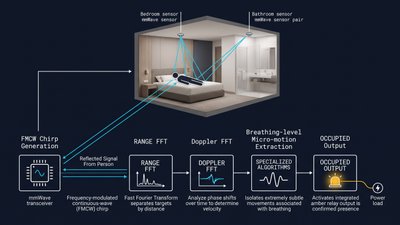
How do hotel thermostats detect occupancy: a ceiling mmWave sensor or a PIR reads presence and drives the AC, while a door switch or card adds a hint.
It supports the same product context: ceiling-mmwave-occupancy-sensor, hotel-occupancy-sensor.
Specify your hotel project with our engineers
Send your room count, ceiling type, and protocol preference. We will return a sample plan and quote within 24 business hours.
- Move from general guidance into a product or application discussion.
- Use RFQ when pricing, drawings, MOQ, or launch timing needs structure.
- Keep a direct contact path visible for fast clarifications and handoff.